20121018

The Book Of English Magic


The Book of English Magic is perhaps worthy of the definitive article in its title. Written by Philip Carr-Gorman and Richard Heygate, this weighty 2009 tome takes it upon itself to cover pretty much everything that has anything to do with magic in England.

I don't quite know what I was expecting from this book.

I got it from The Works. You know The Works! They sell the sort of books that would, otherwise, be clogging up a warehouse.

What brought me to The Works? Providence. But what made me refuse to leave before having bought something?

Was it magic?

Maybe. Or maybe I was just really attracted to the cover.

What would have been nice would have been a detailed history of magical practice in England. Instead, here you have a vague and sweeping history of far too much with far too little focus or detail padded out with practical advice for those who want to learn more.

So, I suppose it's an excellent starting point for those who are interested in the world of magic but too frightened to speak to a witch.


The chapters on Dr. Dee and Aleister Crowley were engrossing enough but frustratingly lacking – at the very least I've identified two areas there in need of further investigation. I was also pleased to learn that the conclusion I've reached in regards to the Tarot is a generally accepted conclusion. And I arrived there myself, through personal experiment and exploration! For one glorious moment, I felt like a gnostic.

The problem for me, though, was twofold. First of all, the tone used was such that I found it hard to devote my attention to numerous chapters. Airy and wistful; I'd have preferred something more scholarly and impartial. Second of all was the amount of practical information and advice offered throughout. You can learn how to do everything: From dowsing to scrying.

Now, don't get me wrong. I've no problem at all with those who practice magic, and I like to think of myself as having an open mind on the existence of forces beyond our scientific comprehension. Hell, I even had a bit of fun exploring the numerogical implications of my name. For what it's worth, it was right on the money. I'm a Seven!

It's just that, were I to sit beneath the Hogwarts sorting hat, I believe that I would immediately find myself placed in Ravenclaw. I much prefer to read and learn about things over actually doing things. Those nasty Slytherin and self-righteous Gryffindor types can keep their Quidditch trophies and their invisibility cloaks. I'll be in the library, wrapped up in books, engrossed in the History of Magic.

So an instruction manual such as this was never going to be of much use to me. As a reading list, though, it seems like it might come in handy.

Was it worth paying so much for a reading list? Hey, we're talking The Works, here. It cost me £1.99.

And, besides. On the same trip to the same shop I picked up something so beautiful that I don't care a hang for having blown so little on something of such disappointing substance.

About which more later.

I'M TRYING TO KINDLE EXCITEMENT, ARE YOU EXCITED?

Death Line (1973)


Here's one I've been wanting to see for some time. Since – oh, I don't know – probably since I read a gushing article about it in a book left in the bathroom by my then-flatmate. I can't remember the name of the book, but it was a pretty insufferable collection of tragically iconoclastic essays concerning various aspects of British cinema. There's “celebrating the less familiar” and then there's “hey, let's stubbornly pour scorn upon anything that's beloved of more than ten people”. This book unfortunately went for the latter approach on far too many occasions, which might explain why I never deigned to remember the its title.

I'm an awful fickle rat sometimes.

But Death Line. Death Line.

They were right on the money when it comes to Death Line.

I know I moan a lot on this site about the state of modern horror. Death Line, though, takes pretty much every single one of the tired tropes about which I'm so fond of complaining and demonstrates how to treat them in such a way as to make a film that's oh so much more than a sum of its parts.

It's about a dying tribe of cannibalistic inbreds who live in the “rabbit warren” that is the London Tube. Trapped beneath the rubble after having been abandoned in the wake of a cave-in, it's implied that life is bleak, damp yet ultimately quite touching underground. Though they've all but lost language, they still communicate; and that they cling to such customs as defined clothing for men and women and even burial rites makes this film, on one level, a subtle exploration of what makes us human.

Only emerging to feast on the flesh of the living, it's likely that their existence would have continued unnoticed but for two reasons. First of all, their last remaining pregnant female just died. Second of all, they made the mistake of choosing, as their prey, one James Manfred – gentleman, pervert, OBE.


Being an OBE, not only does his death invokes the involvement of MI5 (a marvellously creepy cameo from Christopher Lee, above), but it also forces adorably lazy Inspector Calhoun to actually do his job for a change.

Played brilliantly by Donald Pleasence, Inspector Calhoun appears to be the reason as to why so many people rate this film so highly. In that you can tell that, at any given moment, he'd much rather be sat alone with a lovely cup of loose-leaf tea, he's wonderful and strangely cuddly despite his caustic chronic grumpiness.

There's a very long scene in which he and his second in command outstay their welcome in a grotty little pub – getting hammered and eating sausages whilst playing pinball and being really quite rude to the ever-tolerant barman. It contributes precisely nothing to the plot but goes in a long way to explain the appeal of this film: Death Line doesn't appear to take itself at all seriously, but with its fully-drawn characters and carefully considered cannibals, scratching beneath the surface reveals fathomless depth.

The only downside is the American – the eternally dour Alex Campbell, whose character doesn't seem to stretch too far beyond “student”. He's boring and almost threatens to ruin the fun for everyone else, but even he's saved thanks to his really, really lovely girlfriend and the gorgeous book shop in which it works. Wall-to-wall Penguin paperbacks and a big poster of Dickens? If I'm good, that's probably where I'll go when I die. The tea will flow like rivers, and there'll be a really comfy chair in the corner.

Region 2 DVDs of Death Line are surprisingly hard to come-by, but this is one I want to own forever and never give away. It's this close to entering my beloved pantheon of horror alongside The Wicker Man, Eraserhead and Evil Dead 2. I'm almost certain that I've found a new favourite here.

20121011

We Need To Talk About Kevin (2011)

 
We Need To Talk About Kevin tells the story of a high school massacre from the perspective of the killer's mother.

Does that sound like the sort of thing you'd like? Then read the book. Lionel Shriver's novel approaches its subject matter with a chilling restraint. Lynne Ramsay's film adaptation, though beautifully shot and brilliantly performed, ultimately comes across as little more than a nuanced remake of The Omen.

It's worth watching for two things. First, the haunting soundtrack which blends scratchy blues with a strange mix of ethnic instrumentation and industrial droning. Second, the incredible career-best performance of Tilda Swinton.

Swinton is fantastic throughout. She doesn't say much, but she exudes the sort of sadness that you can almost feel as a pressing weight on your chest and stomach – an all-encompassing grief that manifests itself as debilitating fatigue and nausea. Her Eva radiates an unbearable pity which makes the whole film emotionally draining.

But that's part of the problem. We aren't exactly supposed to pity Eva.

In the translation from the page to the screen, we are inevitably robbed of many things. Most obvious is Eva's narration. And, as a result, we also lose a delicious slice of ambiguity.

Eva has a son called Kevin. Kevin is an insufferable monster. But was he born this way?

The book insists that he was indeed born a monster. However, there's the subtle implication that Eva simply didn't lavish him with a sufficient amount of love, patience and attention to prevent his inherent mental health problems from developing into full-blown nihilistic sociopath psychosis.

The film, on the other hand, quite explicitly implies that, despite Eva's best efforts, Kevin was just a bad egg. He was always going to do what he ends up doing.

And that's really quite hard to take. It reduces what is supposed to be an intriguing and gruelling exploration of the nature/nurture debate into the realms of quasi-supernatural horror.

Also, halfway through the film, Kevin grows up and is suddenly played by Ezra Miller. This is the first time I've ever seen Miller in anything, so I'm in no position to assess his chops as an actor. His Kevin, though, just feels wrong. Of course, Kevin is supposed to be an amoral superior husk. But is he really supposed to be so irritating?


In any case, I'm sure he's not supposed to be so attractive.

So yes. Read the book. Apart from anything else, it fills in many, many plot holes concerning “the incident” and even manages something of a happy ending.

At least, it manages a poignant ending which, thinking about it, sort of makes me want to stop living. The film, though, ends in such a way that seems specifically designed to troll those who like closure.

20121009

DC Ghosts!

I think the entire run of DC's Ghosts comic has been uploaded to the amazing Cover Browser website.

I've not read any of these comics and, in all honesty, I'm not sure if I'd like to. The best of these covers present a chilling and complete story in one beautifully drawn tableau. How could the full stories do anything but disappoint?

Below are my favourites, presented without further comment. With just a brief glance you can see exactly what's happening and, in many cases, the implication is bloody terrifying.


20121006

Pictures Of Haunted Houses!

I might as well face it, I'm addicted to Tumblr!

Recently, I discovered the marvellous world of Hallowe'en Tumblrs. You can spend all night looking at aggregated images of ghosts, costumes, sweets, stills and haunted houses. Tonight, we're looking at haunted houses.

Each of these was found on Tumblr, so I've no idea at all where they came from, who drew them, or anything. Hey, I wish I did, alright?


This one's more a haunted village than a haunted house. Evil flows down the hill like green vomit. I bet it smells like damp. Interesting how it seems to stem from the church, isn't it?


This one's not necessarily haunted, but it certainly looks that way. I love the sickly autumnal sunlight, the washing hung feebly out to dry, but I think the artist missed a trick by not putting a decaying bovine carcass at the bottom of that well. Actually, there is something down there, but I can't quite make it out. Any ideas?


They say you haven't made it until you've made the cover of The New Yorker. On October 27 1943, the haunted house had its day. None of those kids were ever seen again.


Ah, here we go. This is the sort of picture you could look at all night. Look at the skeletal fiddler on the roof! The strange clown woman looking out the window. Dr Jeckyl has a laboratory in the west wing. He frequently complains about the noise coming from the hunchbacked organist and the flamboyant magician who live above. Meanwhile a witch shares a cup of tea with The Mad Hatter; a slime creature melts in the bell tower; a cat gets struck by lightning; and Frankenstein's monster does some gardening. Also, for some reason, a mummy. And what are those cheerful little chaps standing by the front gate? And look at that Morticia type woman, letting her pet dragon do its business.

Look to the bottom left! This is a jigsaw puzzle. A very easy puzzle judging by the size of the pieces, but that just makes it the exact opposite of a Lego model: More fun to look at than it is to build.


This one's lovely. I'd like nothing more than to have this blown up and framed with a canvas sort of finish to it. Again, there's nothing to suggest it's haunted per se, but why would somebody leave out so many pumpkins unless they were trying to ward off the inexorable forces of evil? Like all the best horror films, it's what you don't see here that makes all the difference. A fire's burning in the house. Are they having a cosy evening in, or are they getting rid of the evidence? And those pumpkins. What if they were originally facing the other way, but they're slowly turning, one by one, to greet an approaching visitor?


Hey, skeleton child. Stop looking at me.


And finally, this one. Quite underwhelming compared to the others, but still not without its charms. Look at that pumpkin sat grinning on the mound. In his mind, he's Jack the Pumpkin King, and everybody's here to see him.

20121004

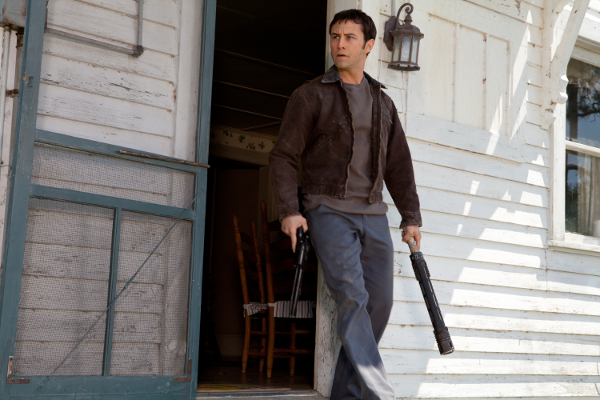
Go And See Looper!


Hey, go and see Looper.

I mean it: Go and see Looper.

You might not enjoy it. You might even hate it. In fact, so many good things have been said about it by so many reliable outlets of wisdom that by now it's almost certain that, at the very least, you'll be disappointed.

If it was doomed upon being declared “this century's Matrix”, that it's now drinking from the poisoned chalice that is the IMDB number one spot I know to be enough for it to be outright blacklisted in the eyes of many.

But never mind. Go and see Looper. If you have any respect for cinema, go and see Looper.

Why? Because Looper is not a sequel. Nor is it a remake. It's not even an adaptation of an existing and already-popular franchise.

It's directed by the same person who wrote it. At no point does it feel like this film was designed to make money. Rather, it feels like it was made because a group of people wanted to tell a story.

More than that, though. They also wanted you to be entertained and to entertain some deep-seated notions concerning cause and effect; Machiavellian politics and telekinesis; selflessness vs. the self. They wanted to excite and enthrall; to move you with their liquid mind bullets squirted directly into the eye.

And, as far as I'm concerned, they succeeded on every count.

You might disagree. And if you did, ace! Let's have a conversation.

The important thing is that this film gets watched and that it gets watched at the cinema.

Because the more this film is watched, the harder it will be for those who sign the cheques to ignore some beautiful truths:

That people will still go and see something daring and unprecedented.

That something doesn't have to be safe and reliable in order to turn a profit.

I really enjoyed Looper. However, I am willing to attribute a large portion of my enjoyment to the feeling I had throughout – that films like this don't come along as often as they should.

Would that they did! Would that they did.

And that's why you should go and see Looper.

20121001

Blood - Original Soundtrack


Must be the season of the witch!

As is common on blogs with black backgrounds and ghostly headers, throughout October you can expect all manner of spooky Hallowe'en related posting round these parts.

Specifically, I intend to share such music as never fails to give me the willies.

To begin with, here's a dark ambient classic that, were it made by the likes of Sunn O))) or Deathprod, would almost certainly be hailed as a harrowing masterpiece by those who care about this sort of thing.

But there doesn't seem to be a lot of crossover when it comes to those who love video games and those who love music. As a result, this particular unnerving masterpiece, has, I fear, been denied  the respect it deserves.


I've mentioned Blood before when talking about those horrible things that make me feel unaccountably Christmassy. It's a horror-themed PC FPS released in 1997. I'm not sure how the game fared when first released, but the game has such a huge cult following that it even has it's own Wiki. To this day, fans even create their own levels based upon their favourite horror films.

It is perhaps of no surprise that such a finely crafted and enduringly popular game should feature a strong accompanying soundtrack. Regardless of their opinion on video games, I would not hesitate to recommend that anybody with an interest in experimental or atmospheric music give this a listen.

The work of one Daniel Bernstein, it plays with numerous tones, textures and genres throughout its 33 minute runtime. Its mood, though, never shifts from one of sustained and delicious dread.
 
Admittedly, if experienced in the cold light of day, a lot of this might come across as quite cheesy. But if it's dark and you're alone and the walls are bleeding, this listening experience can be a thrilling exercise in unremitting terror.

Reminiscent of John Carpenter's synthwork, when you consider that the creepy-crawly opener Cryptic Passage is easily the brightest little ditty on here, you know you're in for a rough ride.

Elsewhere, songs like Unholy Voices and Dark Carnival sound every bit as sinister as their names suggest. The former is somewhat similar to Martin Grech's more godless moments; whilst the latter – with its demented clown laughter and sampled carny cries – wouldn't sound out of place on a particularly horrible Residents album.

The rest is a gloomy soundscape of distant nursery rhymes, harrowing synthetic orchestration and unearthly cultish intonations. In fact, a lot of the time this sounds like a precursor to Mike Patton's Delerium Cordia. Did he ever play Blood? It wouldn't surprise me.

Oh, and speaking of surprises, if you wish for an evening of godless chills, there might be something special waiting for you in the comments section.