Showing posts with label book reviews. Show all posts

20130501

There's No Messing With Doris Lessing


I'm not likely to ever appear on Desert Island Discs, but of the three things they ask of you – seven records, one book and one luxury item – I think I'd have the greatest difficulty in deciding upon a single book to satisfy me for the rest of my days.

Doris Lessing's The Golden Notebook is exactly the sort of book to which you could dedicate a few lifetimes and still uncover fresh layers on subsequent reads.

Yes, this book is layered. But it's not layered like an onion – neat, even and stacked – it's layered like a scrunched up ball of paper – violent, overlapping and chaotic. Less than 100 pages in I understood that this – my initial reading – wouldn't be enough. Having finished it this afternoon I was gasping for breath. It's now been added to a pile – alongside James Joyce's Ulysses – of books that I'll need to read again at some point.

And that pile could act as a shortlist for the sort of books that I could happily take to a desert island, though I doubt that even a few decades in the sun would be enough to uncover all that could be uncovered. These aren't Desert Island Books. They're Eternity Books. Afterlife Books.

Like everything written at any point before today, The Golden Notebook is, in parts, a little dated. It's also utterly, horribly overwhelming. It's about so many things that it would be disingenuous to say that it's “about” any one thing, but it can be broadly summed up as an exhaustive exploration – in extreme close-up – of one woman's nervous breakdown, one thought at a time – over 576 demanding pages.

And in detailing this descent, it touches on so many themes that reading The Golden Notebook is like simultaneously reading five heavy novels at once in the back row of a particularly demanding socio-economic lecture.

Art, literature, identity, humanity, creativity, motherhood, communism, race, sex, gender, betrayal, writer's block – you can't describe this book without sounding like David Bowie describing his latest album.

I was very, very pleased to finish, because every single second spent with The Golden Notebook eventually felt unbearably heavy – just like, I imagine, would every single second spent with depression. I'm glad to have come out from the other side, but I don't regret, for one second, having picked up the book in the first place. Maybe I'll return to The Golden Notebook when I've more time on my hands, more experience under my belt and no tempting pristine copy of Gertrude Stein's Autobiography of Alice B. Toklas – freshly donated by a friend. But until then, I feel drained.
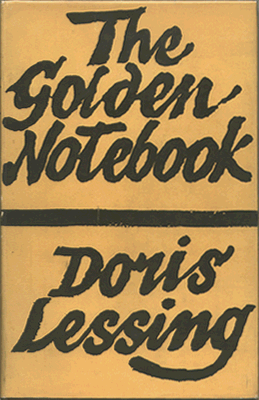


But what a wonderful, indispensable draining experience it was. Because Doris Lessing! This was my first exposure to Doris Lessing, but even if I just had the text of The Golden Notebook to go on, I'd already have enough evidence to suggest that even a word as magnificent as “genius” doesn't even begin to describe her.

Because bookending The Golden Notebook was an preface from Lessing – recently written – and an interview. On this initial exposure, I took much more from her non-fiction than I did her fiction, simply because her words and her ideas are nothing short of inspirational – perhaps even life-affirming.

I've been thinking a lot, recently, about the position of critics in our society. Do we need them at all? Probably not. But Lessing puts their role – their responsibilities – in a most intriguing light:

“...writers are looking in the critics for an alter ego, that other self more intelligent than oneself who has seen what one is reaching for, and who judges you only by whether you have matched up to your aim or not... But what he, the writer, is asking is impossible. Why should he expect this extraordinary being, the perfect critic (who does occasionally exist), why should there be anyone else who comprehends what he is trying to do? After all, there is only one person spinning that particular cocoon, only one person whose business it is to spin it...It is not possible for reviewers and critics to provide what they purport to provide – and for which writers so ridiculously and childishly yearn.”

So according to Lessing, critics have an unrealistic idea of their position in society, and writers have nobody but themselves to blame for this, for it was they who placed critics on their pedestal.

But it apparently goes further than this. Lessing believes that, from a very young age, we're conditioned – even brainwashed – to refuse to recognise the true value and intent of what we read.

“It starts when the child is as young as five or six, when he arrives at school. It starts with marks, rewards, “places”, “streams”, stars – and still in many places, stripes. This horserace mentality, the victor and loser way of thinking, leads to “Writer X is, is not, a few paces ahead or Writer Y. Writer Y has fallen behind. In his last book, Writer Z has shown himself to be better than Writer A.” From the very beginning, the child is trained to think in this way: always in terms of comparison, of success, and of failure.”


Lessing extrapolates political connotations from this – children are conditioned to respect authority, to not think for themselves – but when I read this I also applied it to every other kind of criticism – especially music criticism, the obtuse nature of which has given me so much gripe in recent years.

“These children who have spent years inside the training system become critics and reviewers, and cannot give what the author, the artist, so foolishly looks for – imaginative and original judgement. What they can do, and what they do very well, is to tell the writer how the book or play accords with current patterns of feeling and thinking – the climate of opinion.”


When I read that, I wanted to shout: “Ha! Take THAT, every critic with whom I've ever taken issue.” I wanted to reach through the page and give Doris a high five. 15 pages into my first ever exposure to the writing of Doris Lessing, and I already wanted to marry her.

Critics aren't nearly as important at they think they are – or as they want us to think they are. Instead, due to inherent weaknesses instilled from childhood, they are nothing more than, as Doris so brilliantly puts it, “litmus paper”. They're not arbiters of taste and opinion. They're products of taste and opinion – just like everyone else.

Critics – and writers too – could learn a thing or two from Doris. It seems that the relationship will always be codependent, but there's nothing stopping it from being healthier.

Less cynical and pessimistic – but infinitely more poignant – is the interview included at the end of my copy of The Golden Notebook. Asked if she stops reading other people's books when writing her own, she replies:

“ I have stopped with my current book, because my time is running out. I'm 87 [she's now 93], I'm not going to live forever and I want to finish this book I'm writing now. I'll go back to being a good reader when I finish it.”


Wow.

Finally, she offers a very good reason for good people - “boulder pushers”, as they're called by The Golden Notebook's protagonist – to remain optimistic. She's asked how living through “one of the most tumultuous centuries in our history” has affected her.

“Well, I've lived through Hitler, ranting and raving; Mussolini too; the Soviet Union, which we thought would last for all time; the British Empire, which seemed impregnable; the colour bar in Rhodesia and elsewhere; the heydey of European empires. It was inconceivable to think that these would disappear. They seemed permanent. Now not one of them remains – and I think that is a recipe for optimism!”


So to sum up, I think I'm in love with Doris Lessing.

20130429

Ready Player One - It's Egg Hunting Season!


In little over a week, the whole Boards of Canada Easter Egg Hunt has progressed significantly. At the time of writing, we have five of the six numbers – but we're still no closer to discovering what it all means.

It turns out that The Record Store Day Incident (as it's now being called – how Fortean!) was just the kick-off. Whilst everyone initially thought that there'd be a different code on each of the six records (of which only four have apparently been found), instead it appears that each code will reveal itself in a different way.

First there was all the rigmarole on the band's YouTube channel. Since then, subsequent codes have been variously revealed through clever gif manipulation; through broadcasts on NPR and on Zane Lowe's Radio 1 show (number stations!) and, best of all, through the above advert that was broadcast on The Cartoon Network (of all places).

The most intriguing event, though, has been a projection on the building opposite London's Rough Trade store (where the second vinyl was found). The staff of the store claimed total ignorance. And, despite rumours circulating that the door of the building would open at midnight (for the first Boards of Canada gig since 2002?), very little came of this.


Still, it seemed to confirm not just the authenticity of this whole thing (as if there remained any doubters), but also the unbearably exciting notion that something's happening.

Unfortunately, despite the fact that my love for Boards of Canada runs through me like the lettering on Blackpool Rock, my part in this will only ever be as an observer. With a string of six numbers making up a 36 digit code, it's obvious that this will ultimately present a mathematical problem.

Reincarnation is a nice idea, and I like to think that, before you regenerate, you get to choose certain traits – like an RPG character creation screen. Well, if I'm given a second chance of life, above all I'd like to try my hands at being somebody with an inherent interest in science, technology and mathematics.

At the moment, though scientific and mathematical theories can pique my interest, I feel as though the very wiring of my brain prevents me from truly comprehending anything I read about – let alone from forming or applying any of my own theories.

It's always been like this. At school I pushed myself to get an A in GCSE Maths, but I was really only learning by rote exactly the information that would be required to pass that specific exam. I had no underlying understanding or appreciation of the information, and I promptly forgot pretty much everything I'd learned the second I finally put my pencil down at the end of the exam.

Still. I might not have developed a very scientific mind, but I think I've more than made up for that through my love of music, films, history, words, grammar and stories – by which I mean books.

So whilst I can't play an active part in the Boards of Canada Easter Egg Hunt, I can at least enjoy it as a bloody good story.

And as a bloody good story, it's particularly enjoyable because the whole thing reminds me of a bloody good story I read recently.


Ready Player One by Ernest Cline is a very popular book indeed. It's so popular, that people dress as it for Halloween. Not as characters from the book, mind, but as the book itself.

I don't think even Twilight elicited that level of devotion.

Ready Player One takes place in 2044. The world isn't quite a post-apocalyptic wasteland, but society and the economy appeared to have collapsed and things are quite awful. So most people spend their time inside a ridiculously immersive virtual reality environment called OASIS.

Designed by an obsessive savant called Halliday, I really wish that OASIS actually existed in real life. It's a seemingly infinite universe in which you can be whoever you want, do whatever you want and fully-explore the locations of pretty much any sci-fi or fantasy universe you could care to mention.

Before passing away, Halliday reveals that he's hidden an Easter Egg somewhere in OASIS, and whoever finds it will inherit his vast fortune. The novel details the exploits of a player called Parzival and his friends in their quest to track down this elusive egg.

As the novel goes, it's far from perfect. It's told in the first person – from Parzival's perspective – and it's implied that he's telling his story so that future generations will understand “what really happened”. But if that's the case, I've no idea why he feels the need to pepper his narrative with such excessive cultural-economic infodumps. It's fascinating for us early 21st century readers to get an insight into his world, but surely Parzival's intended audience would already be painfully familiar with the world he's describing? After all, they've never known any other.

The world-building, then, is clumsy at best, and the final “message” appears to undermine absolutely everything that's come before. But still, Ready Player One remains some of the best genre fiction I've read in recent years.

This is partly because it's so engaging. The idea that your obsessive knowledge of pop culture might save the world (a virtual world at that) is very appealing to anyone who likes films, music and video games as more than just part of a lifestyle.

But the most remarkable thing about Ready Player One is that everything Parzival achieves he does so under his own volition - using a combination of knowledge, intuition and incredible courage. Parzival is therefore a real hero, and a most refreshing change from the “chosen one” trope that still seems to dominate genre fiction.

Honestly, is there anything more boring than a meek hero who has greatness thrust upon him? I'm certainly had enough of that idea. From now on, I only want heroes who know what they're doing, know why they're doing it and, crucially, who want to do it.

Which is why Ready Player One is such an engaging, refreshing read. All this useless knowledge I've built up over the years? It might not always be useless.

So my lack of mathematical knowledge might force me to take a regretful back seat in this Boards of Canada Easter Egg Hunt. But you never know. One day, there might be something greater at stake – the fate of the world! - and it might depend on deep knowledge and appreciation of my specific interests.

But until then, hey! New Boards of Canada album!

Probably. All of this has to lead to something.

20130311

Making A Cup Of Tea For Everyone In Belgium & Other Heartwarming Scrapes

In the first decade of the noughties writers everywhere were apparently struck by a desire to have a wacky adventure that just so happened to involve a lot of tax-deductible travel. It resulted in a strange sub-genre of personal quest/travelogue books that to this day dominate charity shops and the humour section of Waterstones.

The adventure was often passed-off as a silly bet, and it invariably transformed into a journey of self discovery. The results were mixed. In some cases you got a genuinely engaging and often hilarious travelogue of intrigue. Mostly, though, you got the literary equivalent of JP from Fresh Meat – droning on about his gap year whilst describing everything as “literally well-random”.

Dave Gorman is the first name that comes to mind. With his Googlewhack Adventure, America Unchained and Are You Dave Gorman? books, he certainly struck upon some truly original ideas. His work is let down, though, by a tendency to take himself – and his self-imposed projects – far too seriously. Each of his books at some point spirals into a really quite terrifying meltdown. You want to reach through the page and say, “Dave, maybe you should calm down a little?”

If Dave Gorman took things too seriously, Tony Hawks had exactly the opposite problem. He travelled Round Ireland With A Fridge, played The Moldovians at Tennis and tried to have a number one single in any country, anywhere. Tony Hawks is a mild-mannered and mildly-spoken man who you might remember best as the “host” of Better Than Life on Red Dwarf, or as the uptight rapper behind The Stutter Rap. His books, though, were painfully obvious attempts to highlight just how quirky he believes himself to be. I gave up after A Piano In The Pyrenees, in which he struggled to wrest anything approaching humour from his relocation to the French mountains.

Then there's Tim Moore, who is funny. Really funny. What sets Tim Moore apart is that, like Bill Bryson (whose travel writing arguably inspired this curious sub-genre), his books are less self-consciously “wacky” projects that happen to involve a lot of travel and more straight-laced travel writing that just so happens to be utterly hilarious. Tim Moore drew comedy not from an absurd situation or idea, but from wry observations about the perfectly normal world around him. He's not a man that places himself in strange situations and begs you to laugh. He's a skilled comedian with a subtle delivery, excellent timing and an impeccable eye for detail. Moments from Frost On My Moustache, French Revolutions, Spanish Steps and Continental Drift are amongst the funniest scenes I've ever encountered in any medium.

So what would you call this sub-genre? The Humorous Travelogue? The Personal Project (With Hilarious Consequences)? The Comedic Wanderer? I don't know, but I was quite sure that the genre had exhausted its potential, and I was convinced that I'd exhausted all the enjoyment that could possibly be drawn from the writings of grown men with too much time on their hands who really should know better.

But then I read The Know-It-All by A.J. Jacobs.


An American journalist and editor of Esquire, A.J. Jacobs endeavoured to read the entire 2002 Encyclopaedia Britannia back-to-back. The Know-It-All is a document of his efforts, and it really is a lot funnier than a literary marathon has any right to be. More than that, it's frequently fascinating, often touching, sometimes sad and shocking and, ultimately, it could even be described as life-affirming.

In reading The Know-It-All, not only did I learn a lot of lethal facts for future deployment, I believe I also stumbled across exactly the reason why so many efforts by Dave Gorman and Tony Hawks failed in their efforts to amuse and engage. Their ideas might have been variously wacky and fascinating, but all too often they approached their projects with a sneer and a smirk. The books can therefore come across as so cynical as to be alienating. It's like they're saying “I know it's stupid, but you're the one who bought this book, aren't you? Have you any idea how rich this made me? And I got to go to China, too. Joke's on you, moron.”

Jacobs, though, seems perfectly aware of his limitations, and doesn't ever shy from sharing his shortcomings or anxieties. At no point does he present himself as the noble or begrudging hero caught up in something beyond or below him. And when his self-imposed task starts to dominate his life, you really do get a sense of how unhealthy his obsession is becoming, and how difficult he himself is becoming for all of those around him.

When Dave Gorman or Tony Hawks complain about their projects, I can't help but roll my eyes. The “problems” about which they complain are even more trivial than first world problems. Jacobs's quest, though, is framed in a narrative concerning father-son rivalry, hypochondria, new parent anxiety and a fear of death, decay and dementia. It's real, it's human and it's affecting to no end. Every time I put the book down, I found myself thinking of Jacobs – hunched over his well-thumbed EB, eyes straining in the darkness, whilst his brooding wife lay neglected, asleep and alone next door.

The sheer scope of his task and the none-more-human element raises this book so far beyond the cynical adventures of Dave Gorman and Tony Hawks that you may as well compare Anna Karenina to Twilight. If you put a thousand Hawks in a room with a thousand typewriters, you'd have to wait years before any of them cranked out anything even half as insightful and touching as this:


“I know that everything is connected like a worldwide version of the six-degrees-of-separation game. I know that history is simultaneously a bloody mess and a collection of feats so inspiring and amazing they make you proud to share the same DNA structure with the rest of humanity. I know you better focus on the good stuff or your screwed. I know that the race does not go to the swift, nor the bread to the wise, so you should soak up what enjoyment you can. I know not to take cinnamon for granted. I know that mortality lies in even the smallest decisions, like whether to pick up and throw away a napkin...I know that you should always say yes to adventures or you'll lead a very dull life. I know that knowledge or intelligence are not the same thing – but they do live in the same neighbourhood. I know once again, firsthand, the joy of learning. And I know that I've got my life back and that in just a few moments, I'm going to have a lovely dinner with my wife.”

The Know-It-All is a celebration of life, of humanity, of knowledge, or learning, of reading, of family, of friends, of food and of brilliance. But in celebrating the brilliance, it can also makes those who can only dream of such lofty heights feel proud of their life and achievements. It champions eccentricity, yes – but never for the sake of eccentricity. It made me laugh, but it also made me feel gifted – lucky to be breathing and genuinely happy to be alive.

Piano In The Pyrenees, though? That just made me want to read something – anything – else.

20130115

Dancing To Architecture Part 2 - Gateways To Obsession


Continuing my dubious denouement of Nick Hornby's 31 Songs, I'd like to call your attention to something.

No, please, stay with me. This is interesting. You might like where I'm going with this.

This is Nick Hornby in reference to his love for Rod Stewart. Ignore his irritating and outmoded tendency to refer to all music that isn't jazz or classical as "pop music" and look at this:

“...the people who stick with pop music the longest...are those who entrust themselves at a tender age to somebody like Stewart, somebody who was clearly a fan himself. Those who fell for The Stones got to hear, if they could be bothered, Arthur Alexander and Solomon Burke and Don Covay...Zeppelin fans might have been moved to seek out Muddy Waters and Howlin' Wolf.”

Remember, Hornby believes that those whose opinions differ to his don't really like music. Witness:

“The antecedents of Yes and Genesis were Pink Floyd, and before that nobody much, really, and that was, in retrospect, part of the reason I didn't like them very much. The music felt airless and synthetic, and it seemed even then as if all the prog rockers would rather have been classical musicians, as if pop were beneath them, somehow. They led you up a blind alley; there was nowhere to go.”
OK. Ignoring, for one moment, the fact that Pink Floyd's very name is derived from two old bluesmen (the work of Pink Anderson and Floyd Council could therefore be considered as highly valid antecedents to Pink Floyd), what's wrong with a rock musician aspiring to be a classical musician? Nothing much, really.

Hornby claims to dislike prog rock because it's a “blind alley”. Once you've listened to the big names, there's nowhere else to go.

This is nothing short of absolute horsetwaddle. Beyond the classical and avant-garde composers from which prog rockers ostensibly took their cues (Hornby evidently believes that such music is beneath him), it's important to remember that a major antecedent to prog was psychedelica. Psych is to prog what punk is to New Wave; and psyche is an ocean of considerable depth into which millions of intrepid musical obsessives delve every day.


With psyche, you've got a vast pantheon that thrived on both sides of the Atlantic. For just the very apex of the iceberg, think of The Kinks, The Beatles and The Who in the UK; Jefferson Airplane, Jimi Hendrix and The Grateful Dead in the US. Each of those bands offer a unique entry-point into a vast world of new musical discoveries, and you'll have a vastly different experience depending on where you happen to start. The Grateful Dead alone must surely have enough material to keep you happy for life.

And every single one of these musicians took inspiration from expansive swathes of roots, folk, country, blues etc; again from both sides of the Atlantic. Also, going on at the same time was a vibrant scene of bands who might only have recorded and released one single before fading into obscurity. So if the past holds no interest for you, why not explore the present? Nuggets is just a tiny, tiny bite of something immense. That's why they called it Nuggets. And trace a path forwards from Nuggets and you get to garage rock, punk, New Wave, indie...

So you see, even if you use Pink Floyd as an entry-point, you've got enough musical exploration to be getting on with to nourish you for a lifetime.

From this we can draw two conclusions. First of all we can reiterate that Hornby is a pretentious bore who, when you apply even a base amount of scrutiny to his assertions, clearly doesn't have the slightest idea what he's talking about.

Second, we can conclude that, if you like music enough, it really doesn't matter where you begin. Any band, scene, musician or genre can act as a viable entry-point into an obsession just as deep as Hornby's. Just as deep, but if you grew up with internet access, your love will likely be a lot more open-minded.


To illustrate my point, I'd like to talk about my own entry-point into what I already know will be a lifelong obsession with music (and not just “pop music”).

I believe I started with Radiohead. I still consider them my favourite band, and one major reason as to why I continue to value them above all others is because it's now possible to view them as the centre of an immense hub from which everything else I love stems. I could likely trace any band or musician I value back, in some way, to my early love for Radiohead.

It began when my brother bought the Paranoid Android single from a street vendor in Glastonbury (the town, not the festival). That song, and the two b-sides (Polyethylene pts. 1-2 and Pearly) would sow some highly potent seeds, but things wouldn't take off in earnest until the release of Amnesiac. You And Whose Army?, heard on a Q best of the year CD, was unlike anything I'd ever heard before. You could say it blew my mind.

I saved up for, bought and immersed myself in the album. It was the start of something beautiful, and I freely acknowledge the role of the internet in kindling my love. I would scour online archives for hours for any material pertaining to Radiohead, and as I went I was making an unconscious mental note of any and all bands or artists listed as influences or descendents.

In this way I got into Aphex Twin and, as a result, most everyone on the W.A.R.P roster. Brian Eno, too, and Jeff Buckley. Remixers such as Four Tet and Zero 7. Krautrockers such as Can, Faust and Kraftwerk. Contemporaries such as Martin Grech, Beck, Sigur Ros and Clinic. In recent years I've started to discover the daunting but enthralling world of jazz. Call me a philistine if you must, but I entered via the very sounds referenced by Radiohead – John Coltrane, Charles Mingus, Miles Davies – the same names that get everyone into jazz, surely; but I know that I might never have even considered making the leap were it not for Radiohead.

But perhaps most importantly, my love for Radiohead made me pay more attention to the music to which I already had access. Adventurous 90s guitar bands such as Blur, The Auteurs and Super Furry Animals wouldn't hold nearly as much sway over me were it not for Radiohead; whilst my parents' Pink Floyd and Genesis albums (on which I had basically been raised) suddenly seemed a lot more interesting.

So I got into prog rock. I even considered Radiohead to be prog rock. For a long time, I referred to myself as a prog rock fan. I still do, but for a long time I was all about the prog. The proggier the better.

And from there – well, see above.

If the potential for deep musical appreciation is within you, it doesn't matter in the slightest where you start. If it's in you, through an insatiable need for sustenance, you'll eventually find your way to achieving that ideal state – a love for music that's free from the artificial constraints of time, space and cool.

Nick Hornby thinks he's there, but he isn't. How can we tell? Well. Because he doesn't see how genres he dislikes (classical, prog etc.) can be worlds in themselves – worlds which are, importantly, inexorably linked to that which he values so much. And even if they aren't linked, they're no less valuable. And because he can't see that, well. I hate to say it, but it might be the case that he doesn't really like music at all.

20130114

Dancing About Architecture Part 1 - Nick Hornby's 31 Songs

I read 31 Songs by Nick Hornby. It could be pointed out that it's a waste of time to review a book originally released over a decade ago. But it's OK. Nobody reads this blog for hard-hitting opinions on things that are actually happening now.

There might even be scope for removing all but the first four words of that last sentence, but that's another argument.

31 Songs, then. In this book, Nick Hornby writes about 31 songs that he loves (or has loved). I was dubious to begin with, because on the surface the whole thing looks like a navel gazing vanity project. And that's exactly what it is. Though it's obvious that Hornby's love of music runs deep, I've no idea why he wrote this book. It's a loose and unusual concept; an answer to a question asked by nobody: So why do you like music, Nick?

The problem is that, for Hornby, appreciation of music is akin to membership of an elite club. It was probably this belief that influenced him to take to his keyboard to begin with. Hornby wants it to be known that not only is he a high-ranking member of this illustrious club, he's also the arbiter of who may and may not be granted entry. For you ultimately get the impression that, for Hornby, there's no greater insult than to insist that one doesn't “really” like music.

And, surprise surprise, throughout the book it's revealed that those who dare to like the music that Hornby doesn't (or, even worse, those who like music in the wrong way), don't “really” like music at all.

Those who like a song because it reminds them of a certain time, place or person don't really like music. Those who like classical music don't really like music. Those who listen to sample-based music don't really like music. Those who “still” enjoy loud guitar music don't really like music. Those who don't like Rod Stewart but who do like Pink Floyd or Elton John don't really like music. Those who enjoy solos don't really like music. Those who like Bob Dylan more than he does don't really like music. Those who don't listen to lyrics don't really like music. And, perhaps most heinous of all, those who like extreme or experimental music not only don't really like music, but they must also have lived unfulfilled lives to have developed such tastes.

Well. I'm a Pink Floyd fan. I definitely like Bob Dylan more than he does, and I often find myself moved by classical music, extreme music, experimental music and sample-based music. I love solos and I don't always listen to lyrics. I still love loud guitar music; and I attach strong memories of people, places and periods to pretty much all of my favourite songs. I definitely like music, but according to Hornby's condescending absolutism, I don't really like music.

So you'll forgive my pettiness in deciding that those who write intimate, confessional non-fiction in exactly the same voice as every single one of their fictional protagonists – be they male or female, old or young – can't really write at all.

Credit where it's due, though. The chapters concerning Hornby's autistic son are so vulnerable as to be genuinely affecting. Also, like all people who consider music to be more than simply part of a lifestyle, Hornby obviously spends rather a lot of time thinking about things. When he's not insisting that those who see or enjoy things differently to him are somehow inferior, Hornby strikes upon some genuinely intriguing ideas.

For example, he has the future of music criticism nailed:

“This is what has to change, if pop music is to survive...we must learn the critical language which allows us to sort out the good from the bad, the banal from the clever, the fresh from the stale; if we simply sit around waiting for the next punk movement to come along, then we will be telling our best songwriters that what they do is worthless, and they will become marginalised. The next Lennon and McCartney are probably already with us; it's just that they won't turn out to be bigger than Jesus. They'll merely be turning out songs as good as Norwegian Wood and Hey Jude, and I can live with that.”

31 Songs does contain a few moments of right-on inspiration, and all obsessive music fans are doubtlessly as arrogant as Hornby. Perhaps, in the face of his few genuinely thought-provoking ideas, we should forgive his small-minded tedium?

Perhaps. But then you come to the addendum, in which Hornby takes it upon himself to listen to the current top ten albums in America. And suddenly, 31 Songs is read through your fingers as Hornby unwittingly becomes the most out-of-touch square that ever walked the earth. This chapter perhaps marks the precise moment at which Hornby enters middle age, and it makes for an excruciatingly painful read. His “knowing” assessments of the music of Alicia Keys, Stain'd, D12, P Diddy and Blink-182 read like blustered biological field-notes. I don't hold any of those artists in anything approaching esteem, but it's suffocatingly cringeworthy when Hornby insists that, of course, his music is objectively superior. He even warns, in words that read like a 50s B-Movie horror announcer, that there might be someone listening to Blink-182, right now, on your street. Oh no!

At the very least, 31 Songs has made me able to decide upon the exact definition of “good” music writing. It's simple: Good music writing makes you want to listen to music. At times, 31 Songs undoubtedly achieves this. I certainly want to hear a lot more Teenage Fanclub having dragged my way through Hornby's book.

Bad music writing, on the other hand, can be many things; but three huge warning signs are that a) clear and definite battle lines are drawn between “real music” and, presumably, “fake music”; b) clear and definite battle lines are drawn between those who “really” like music and those who don't and c) it's hinted that music simply isn't as good as it used to be.

As a result, at its worse 31 Songs is a definite example of bad music writing; and reading it is often an experience akin to being cornered by that droning musical bore at a party who laughs at your Gomez t-shirt.

20121104

The Lancashire Witches


I picked up my copy of The Lancashire Witches in a Manchester branch of Oxfam. Although it appeared in the classics section, I initially supposed it to be a product of the Dennis Wheatley school of 20th century occultsploitation trash.

I bought it anyway. Partly because I've always been attracted to the idea of dark Sabbaths on Pendle Hill, but also because I'm exactly the sort of person whose questionable interests were ripe for exploitation by Wheatley and his ilk.

I was surprised to learn that William Harrison Ainsworth was not a contemporary of Wheatley. Rather, he was a contemporary of Dickens and Thackeray. He appears to be remembered by few and read by even fewer.

The Lancashire Witches is the only one of Ainsworth's 40 novels that has remained in print since it's initial 1848 publication. Wouldn't it be wonderful if here we have a forgotten masterpiece from a forgotten genius whose visionary style easily matched – nay, surpassed – that of Dickens?

Sadly, no. I hate to say it, but the reason Ainsworth is arguably all but forgotten might have a lot to do with the fact that he really wasn't very good at writing.

If you want a harrowing account of the accusations of witchcraft that made life a living hell for the innocent women of Pendle exactly four hundred years ago, look elsewhere. In The Lancashire Witches you'll find little to love beneath the stodgy mire of purple prose and class-based snobbery.

Really, I'm amazed I managed to persevere with The Lancashire Witches. The first 15 pages or so were utterly dreadful. Ainsworth enjoyed drowning his readers in overwhelming dumps of information. Not content with overloading his paragraphs with socio-economic explanation, he also has his characters greet each other with long-winded exposition.

Witness this sterling example of naturalistic dialogue:

“Night is approaching,” cried the tall man in the velvet mantle impatiently, “and still the signal comes not. Wherefore this delay? Can Norfolk have accepted our conditions? Impossible! The last messenger from our camp at Scawsby Lees brought word that the duke's sole terms would be the king's pardon to the whole insurgent army, provided they at once dispensed, except ten persons, six named, and four unnamed.”

717 pages of that would be bad enough, but it gets worse. That's just how the nobility speak. Anybody who isn't rich or good looking is cursed to speak in some downright insulting dialect which comes across as an approximation of no language ever spoken by anybody, ever:

“Ey knoas neawt abowt him, lort abbut, 'cept that he cum to Pendle a twealmont agoa...boh ey knoas fu weel that t'eawt-cumbling felly robt me ot prottiest lass i' aw Lonkyshiar – aigh, or i' aw Englonshiar, for t' matter o' that.”
You get entire pages rendered unintelligible by that condescending literary device. Worse still, things are seldom “said” in this book. Rather, they're cried, observed, pursued, muttered and, at a particular low point, vociferated.

But beneath all these crimes against writing, does there lie a bloody good story just waiting to be unearthed by those with fewer literary neuroses than I?

Very, very nearly. Once things get going, The Lancashire Witches almost draws you in. The opening scenes, in which a curse is cast upon the Demdike name for all eternity, is marvellously gloomy. Also early on comes a brutal and rather upsetting account of a trial by water for a young maiden.

But the more the book progressed, the more I started to feel nauseated. The Pendle “witches” were not, of course, witches. They were innocent and misunderstood women persecuted by a misogynistic patriarchy and a merciless careerist judge.

The Lancashire Witches, though, is not a historical novel. It's a romance. In this book, witchcraft is a very real force. Therefore, the misogynistic patriarchy, though presented in a less than flattering light, really is portrayed as ultimately acting in the best interests of good Christians everywhere.

It's also the case that pretty much every woman who turns out to be a witch is suffering from some kind of deformity. And, of course, generally without exception they speak with the aforementioned ludicrous “dialect”.

Frankly, the idea that the wrongfully persecuted might have had it coming is such an offensive idea that maybe the work of Ainsworth is best forgotten after all.


Oh, but don't feel bad for him. Reportedly, on completing The Lancashire Witches, Ainsworth was paid £1000 and granted full copyright of his work. In today's money, that's roughly £78,600.

So whilst he's perhaps to be denied immortality, it's probably safe to say that he had a good innings.

If you want to read The Lancashire Witches, it's available as a free e-book from Amazon.

I cannot stress this enough, though: I wouldn't recommend it.

20121018

The Book Of English Magic


The Book of English Magic is perhaps worthy of the definitive article in its title. Written by Philip Carr-Gorman and Richard Heygate, this weighty 2009 tome takes it upon itself to cover pretty much everything that has anything to do with magic in England.

I don't quite know what I was expecting from this book.

I got it from The Works. You know The Works! They sell the sort of books that would, otherwise, be clogging up a warehouse.

What brought me to The Works? Providence. But what made me refuse to leave before having bought something?

Was it magic?

Maybe. Or maybe I was just really attracted to the cover.

What would have been nice would have been a detailed history of magical practice in England. Instead, here you have a vague and sweeping history of far too much with far too little focus or detail padded out with practical advice for those who want to learn more.

So, I suppose it's an excellent starting point for those who are interested in the world of magic but too frightened to speak to a witch.


The chapters on Dr. Dee and Aleister Crowley were engrossing enough but frustratingly lacking – at the very least I've identified two areas there in need of further investigation. I was also pleased to learn that the conclusion I've reached in regards to the Tarot is a generally accepted conclusion. And I arrived there myself, through personal experiment and exploration! For one glorious moment, I felt like a gnostic.

The problem for me, though, was twofold. First of all, the tone used was such that I found it hard to devote my attention to numerous chapters. Airy and wistful; I'd have preferred something more scholarly and impartial. Second of all was the amount of practical information and advice offered throughout. You can learn how to do everything: From dowsing to scrying.

Now, don't get me wrong. I've no problem at all with those who practice magic, and I like to think of myself as having an open mind on the existence of forces beyond our scientific comprehension. Hell, I even had a bit of fun exploring the numerogical implications of my name. For what it's worth, it was right on the money. I'm a Seven!

It's just that, were I to sit beneath the Hogwarts sorting hat, I believe that I would immediately find myself placed in Ravenclaw. I much prefer to read and learn about things over actually doing things. Those nasty Slytherin and self-righteous Gryffindor types can keep their Quidditch trophies and their invisibility cloaks. I'll be in the library, wrapped up in books, engrossed in the History of Magic.

So an instruction manual such as this was never going to be of much use to me. As a reading list, though, it seems like it might come in handy.

Was it worth paying so much for a reading list? Hey, we're talking The Works, here. It cost me £1.99.

And, besides. On the same trip to the same shop I picked up something so beautiful that I don't care a hang for having blown so little on something of such disappointing substance.

About which more later.

I'M TRYING TO KINDLE EXCITEMENT, ARE YOU EXCITED?

20120831

Stephen King - The Stand (Unabridged Version)


It's funny reading reviews of Stephen King books on Amazon. Each one seems to have a cumulative four-and-a-half star rating. This is the result of over 200 five-star reviews countered by seldom less than ten one-star reviews.

Every single five-star review proclaims the book to be a masterpiece and King to be a genius. Each one-star review talks about how they've never read King before “and certainly won't again!” Comments are made on the book's length (always excessive) and, if they're really in the mood for trolling, they hint at how their tastes are too highbrow for King and express no surprise that something so asinine should be so popular.

The real tasty meat, though, is in the comments that accompany these one-star reviews. The best ones attempt to shame King's detractors into submission by hinting that only people who have written novels may criticise them. Most of them, though, sarcastically recommend that the reviewer try something a little more suited to their tastes next time. Enid Blyton was a particularly good recommendation from one disgruntled King fan. Ho, does he have his fans. And his detractors!

Which is why, as most people are surely aware by now, the only reviews of any value on Amazon are those with two and three-stars. They may still have an axe to grind, and they may still be unforgivably snarky, but at least they're a bit more balanced. I prefer “I liked it, but...” to both “OMG MASTERPIECE” and “BURN IN HELL KING”. Acknowledgement of flaws with appreciation of saving graces – that's good criticism. Anything else is tedious and laughable. Just as it's quite impossible for anything to be perfect, it's surely more ridiculous to suggest that something can be so completely devoid of merit.

And that's where I fall when it comes to King. By virtue of his prolific output alone, I do happen to think he's a genius. His imagination seems limitless, his characters often feel like exactly the sort of people with whom you'd enjoy sharing a beer and a natter, and every book of his I've read has been so engaging that I'm tempted to use the old “unputdownable” nugget.

Admittedly, in the landmass of fiction he's crafted I've not even begun to scratch the surface, but still: this year alone I've read over 2,100 pages of his work. I think I may already have graduated from “newcomer”.

2009's Under The Dome formed a large part of this summer's holiday reading. That I really enjoyed, but was bemused by the amount of one-star reviews on Amazon which appeared to have been written by his fans. Ho! They all said that Under The Dome was little more than a lesser version of The Stand.

So I went and read The Stand.

In a way, those who criticised Under The Dome are right: It is a lesser version of The Stand. Under The Dome details the experiences of ordinary people placed in extraordinary circumstances. The Stand does the same, but on a much larger scale. That is, an entire continent as opposed to the small town trapped Under The Dome.

Both novels can, to a point, be classed as “experimental” in the Zola sense of the word. A cast of characters is devised to whom pressure is applied. King then explores, almost organically, the ways these people react. At times, it's almost as if he's asking himself – what would happen?

The Stand is a plague novel in which most people die. A lot of the time, even those who survive die. I wasn't surprised to find that it was inspired by George R. Stewart's Earth Abides, which focuses upon the attempts to rebuild society in the wake of apocalypse.

Earth Abides, though, is gentle, elegiac, hopeful. The Stand is brutal. Don't get too attached to anyone, kids. Most of them are going to die, and Stephen's going to do his best to ensure that they die in the worst way possible.

The apocalypse in Earth Abides was neat, almost graceful. All those afflicted with the humanity-negating pandemic were polite enough to die sequestered together.

In The Stand, though, the end of the world feels like the end of the world. Order is lost almost immediately, yet those at the top continue to try, with grim desperation, to cover up the fact that the holocaust was their fault. The results are predictably horrific, and the chapters which detail the downfall of humanity would be gruelling and nauseating were it not obvious that King is taking such delight in telling us about it.

After the plague and the apocalypse comes no small amount of wandering aimlessly in the wilderness and a massive amount of sociological discussion and town planning. It was here that the similarities to Earth Abides were really felt. But, again, King's pandemic had a lot less manners. There're fires, violence, alcoholism, rage, jealousy, terrorism, scandal, intrigue, solipsism and bodies – lots and lots of bodies. The post-apocalyptic landscape in Earth Abides was surprisingly empty in that respect.

And it's at this point that I became convinced that King has a horrible little voice at the back of his mind which screams at him to lace everything he writes with evil. It was a suspicion which first arose when I read L.T.'s Theory of Pets in Everything's Eventual. That was an amusing short story about the steady decline and evaporation of a relationship. But whilst writing it, King must have remembered that he's supposed to be a horror writer. As a result, a serial killer was inserted for no real reason at all, which meant that what could have been a really memorable piece of writing was utterly derailed.

I got the same impression from the latter half of The Stand. Why, in a novel which kills off 99.4% of the human race, did King still feel the need to include the embodiment of evil himself? To spice things up a little?


Yes, Randall Flagg shows up about a quarter of the way through affairs and threatens to ruin everything. He's the devil; evil incarnate; and he wants nothing more than to destroy the survivors of the Project Blue pandemic because...

...well, who cares about motivation, hey?

As villains go, Randall Flagg is unforgivably lazy. Why bother with exposition and motivation when you can just call your antagonist evil-incarnate and be done with it?

If ever a book didn't need an antagonist – or a supernatural element, for that matter – it's The Stand. It's a completely superfluous embellishment to a story which was already equally as horrifying as it was poignant and affecting.

Without Flagg, this book would likely have been worthy of the “masterpiece” tag. It would have been particularly chilling in that mass genocide would have been effected by little more than human arrogance, paranoia and incompetence. It would have been a realistic, believable and, worst of all, plausible document of apocalypse in real time. The latter half would have come across as a grittier Earth Abides. It would have been brilliant.

Instead, though, we get the devil walking the earth performing deeds so evil they're ridiculous. And when things are ridiculous, they're not scary. Similarly, when a villain is without motivation, he's boring.

I'm not quite sure what happened. My theory is that King was getting quite bored by the whole meticulous minute-taking of the Border Free Zone. Having written himself into the corner, he decided to shake things up a bit. That horrible little voice in the back of his head must have piped in - “you need a villain.”

Well, if he wanted a rude interruption to the whole rebuilding society conceit, he could have retained the disaster that springs from Harold Lauder's superiority and jealousy. That, in fact, would have made for an unforgettably powerful explosion of an ending. There would have been marvellous ambiguity, and what is perhaps the most terrifying vignette a horror writer could ever hope to craft – that no matter what happens, we're all doomed to do unspeakable things to each other until we're here no more.

But no. Instead we get a further 500 pages or so of religious crusading against an implausibly evil villain. Has nobody ever told Stephen that it's fine for books to be shorter than 500 pages?

Ultimately, I much preferred Under The Dome to The Stand. Under The Dome might have operated on a smaller scale, but it was much stronger for it. Though King never quite comes across as being out of his depth in The Stand, with Under The Dome it felt like he was completely in control at all times. The action takes place in a sealed microcosm environment, so you're never left wondering what happens everywhere else. In The Stand, for instance, I often wondered why the ultimate battle between good and evil had to take place in America. Surely it should, logically, have taken place within praying distance of the Holy Land?

And, apart from anything else, Under The Dome's protagonist was so believable as to be greatly disturbing. Jim Rennie, the arrogant small-town demagogue with ideas so far above his station that he'll stop at nothing so long as he gets to feel powerful. The real terror was in the realisation that the world's run by people like that.

Randall Flagg, though, can only really inspire terror if you flog yourself before a crucifix every morning.

I suppose my next step would be to enter The Dark Tower territory. I'm put off, though, having learned that Randall Flagg infects its many, many pages. Hasn't he done enough damage already?

But as if that's going to stop me.