20130611

First Listen - Boards of Canada - Tomorrow's Harvest


I've said before how much I dislike doing things for the first time. Reading books is fine, and watching plays, but when it comes to films and albums, your first impressions are to be distrusted at all costs. Your first exposure to something  is an experience to get out of the way as soon as possible. Only once it's been overcome and your mind's free of preconception and prejudice can you truly appreciate what's there to be appreciated.

First listens are problematic enough when it's an album by The National or My Bloody Valentine, but when it's your very favourite band? How are you supposed to approach something so weighty?

One of two ways. Either you make the circumstances as informal and off-hand as possible or you go to great lengths to make things special and memorable. Having pre-ordered it the night it was announced, I had always assumed that my first listen to Tomorrow's Harvest – the new Boards of Canada – would be on headphones, in the dark, on vinyl. Yeah. I'm one of them.

I'd completely forgotten, though, that my vinyl pre-order also came with an MP3 download code. And last night I found myself alone in the dark, a little drunk, a bit sad and quite scared. Perfect circumstances, I thought, to listen to Tomorrow's Harvest for the first time.

But it seems I was more drunk than I previously thought. Because I woke up this morning with no recollection of having listened to the album. However, I find that I'd posted a stream of hysterical messages on Twitter, along with a series of images sourced from lord knows where.

Looking at those messages and images this morning, I realise two things. First of all, that I must have had rather a lot of wine last night. Second of all, that I must listen to Tomorrow's Harvest again as soon as possible.


“62 minutes and I'm in love with life again (if a little terrified of the future)”
“IT'S THAT GOOD. IT'S FUTURE FEAR AND PAST YEARNING UNITED IN PRESENT BALM”
“Hey, Boards of Canada? You make EVERYTHING seem OK. I need you. As it happens. Who knew?”


“Oh lord. This is already filling the hole only partially filled by Pye Audio Corner and Ghost Box over the past 8 years.”

“NO MUSIC HAS EVER BEEN OR WILL EVER BE BETTER ARGH I'VE MISSED THEM SO MUCH”

“THIS IS WHY MY DREAMS HAVE BEEN SO MONOCHROMATIC FOR THE PAST 8 YEARS DON'T LEAVE ME AGAIN”


That, evidently, is how you handle first listens. It turns out you have to be drunk and it has to be dark.

20130512

Post-Rock - Then What? Bill Drummond Says...


Some ten years ago Bill Drummond – a pretentious stain who's successfully post-moderned himself into almost total obscurity – did something utterly unforgivable. He took his midlife crisis and attempted to turn it into an art movement.

Upon realising that he didn't like music as much as he used to, he transformed what was most likely a dopamine release failure into a much wider “problem” with music itself and attempted to instigate an international day of “no music”.

He wrote:

“All recorded music has run its course.
It has all been consumed, traded, downloaded,
understood, heard before, sampled, learned,
revived, judged and found wanting.
Dispense with all previous forms of music and
music-making and start again.
Year zero now.”

And, with all due respect, the moment I read that I immediately lost all respect I could ever have harboured for Mr. Drummond. What a tedious embarrassment of a piss-artist.

Anyway, Mr. Drummond just turned 60, and he spent 17 hours of his sixtieth birthday stood on a manhole cover at the bottom of Liverpool's Matthew Street (because he's Bill Drummond). It turns out that he's been training a choir, and he didn't want to unleash it upon the world before turning 60 (because he's Bill Drummond).

In his words:

“People who have ever had any success within popular music (which I guess includes me) should never think their success gives them the right to do other art forms. The history of pop being littered with examples of highly regarded musicians who then go and embarrass themselves and compromise their achievements by attempting to mount exhibitions, publish novels, compose concertos, or even save the world.

"I did not want to be one of those.”

If his ethics make doing anything such an immense problem, surely he'd be much happier not doing anything at all? I for one would applaud his quiet retirement, so long as it was as quiet as it could possibly be. Silent, even.

But this is interesting. To quote Carrie Bradshaw, I got to thinking...

Specifically, I got to thinking about the subsequent careers of those “who have ever had any success with popular music”. It's fascinating, isn't it? If you've spent a significant portion of your young life playing chords, singing songs and giving interviews, what then?

I'm always keen to find out.

I once read that an ex Boo Radley now teaches IT, and that someone from The Thrills is now quite a whiz at LinkedIn.

And whilst those two fates are, in themselves, quite interesting, I have a couple of case studies which I find to be almost inspirational. As in, despite what Bill Drummond insists, creative minds need not be consigned to a single medium. Everyone's got a “right” to do whatever they want with their lives – not just “other art forms”, Bill.

For starters (and, you'll soon see, that that was a very clever pun), let's look at Sam Herlihy.

Sam used to sing and play in The Hope of the States. Now he writes about food. Sam Herlihy is a food writer. I don't read many food writers, but I don't think I've ever read better.

Sam Herlihy can write. His lyrics for The Hope Of The States could tend to be a bit overwrought, but Jesus Christ, his food writing's incredible. It's tangled, rambling, caustic and utterly delicious. It's like haggis served atop a bed of green spaghetti washed down by cheap wine that tastes expensive.

Some choice excerpts:

“Quorn is to food what Japanese-porn is to porn; weird, the best bits blocked out, really grim and miserable.”

“I have been forced to change my cooking style. Out with my usual spicy Asian Szechuan hipster fatty nonsense and in with plainer food. More simple food? No, I can still render our kitchen as downtown Nagasaki if a fridge had exploded instead of an atom bomb. Quicker food? Nope, I can still take four hours over the cooking. Nicer food? Nah, it’s not my world this butter and potato and rosemary planet. My food is trying to be ‘Bladerunner’ and Raiden from ‘Mortal Kombat’ and this stuff is all period drama Keira Knightly and Mr Darcy britches or something.”

Not only do I want to eat that man's food, I want to listen to him – all night – talk about whatever he wants to talk about. Having read just one of his articles, Sam Herlihy instantly leapt to the top of my fantasy dinner party guestlist. He's not only the guest of honour, though. He's now also the chef.

What makes his writing so compelling is its very groundlessness. His tangents, his anecdotes, his crazy ideas and the impression you get – probably accurate – that he's writing this in one sitting and has something of a cavalier attitude towards editing.

He's apparently burning up with bitterness and resentment (he doesn't have a lot of nice things to say about Morrissey, for example), but never is his writing more engrossing than when he hates on himself. This one, where he talks about finding his first ever restaurant review, is priceless.

But it's never more fascinating than when he veers wildly from the topic of food to talk about what must be his deepest passion – music. This one, on the discrepancy between skill and technique, is truly one of the finest, most compelling pieces of music writing I've ever read.

So that's Sam Herlihy. The Hope Of The States were brilliant, but I do believe that in food writing he may have found his true calling. Take that, Bill.

And then comes Crispian Mills. It may not be wholly accurate to talk about his latest endeavours as a “post” musical career, as Kula Shaker still seem to be an ongoing concern, having released an album as recently as 2010. But again, as much as I enjoy Kula Shaker, I do believe that Crispian Mills was always supposed to be a writer/director.


His debut film is A Fantastic Fear of Everything. It didn't appear to make much of an impact upon release, but having just watched it, I believe it to have all the trappings of a future cult-classic.

It's a strange film set in a strange world. Like the films of Wes Anderson, it's not exactly a period piece, but nothing's new. This is a terrifyingly oppressive world in which bookshelves turn into skulls, launderettes are the scariest places imaginable and you're still allowed to smoke in restaurants. Everybody's dressed like it's the 70s and they listen to gangsta rap on cassette.

Simon Pegg plays Jack, an accidental children's author with a carving knife glued to his hand. He's driven himself to the point of insanity through researching Victorian serial killers, and his life becomes unbearable when he learns that he'll have to visit a launderette.

Jack is like a cross between Withnail and I, and it therefore comes as no surprise that the film's based on a Bruce Robinson short story. But what's truly remarkable was the look and feel of the film. Crispian Mills, responsible for such lyrics as “you're a wizard in a blizzard”, directs like Edgar Wright and Michel Gondry collaborating on an episode of Psychoville. It's unhinged, hysterically stylised and absolutely beautiful to look at. Best of all, though, are the periodic forays into stop motion animation by co-director Chris Hopewell (who was responsible for Radiohead's There There video).

A Fantastic Fear of Everything is one of those films that's “not for everyone” (but what film is?), but it left an indelible mark on me. I won't stop thinking about this film for some time. It's imperfectly structured and, at times, somewhat clumsy in its execution, but credit where it's due - this is a directorial debut. I'm just...stunned that the man who wrote Govinda should go on to create a film that pays tribute to both Michael Mann and The Hedgehog in the Fog. Incredible.

Bill Drummond wouldn't like A Fantastic Fear of Everything, and he'd probably find Sam Herlihy's writing a little tough to swallow. But then, Bill Drummond doesn't actually like anything (because he's Bill Drummond).

Personally, I find it quite wonderful that these two musicians (who were, in the grand scheme of things, “also rans”) should have avoided disappearing completely. That their subsequent work is, in some ways, a lot more appealing than their music perhaps ever was should be a real “egg on the face” moment for old Bill.

I hope for similar changes in direction for all of the stars of Britpop and its immediate aftermath. Maybe Shed Seven could open a holiday camp!

20130501

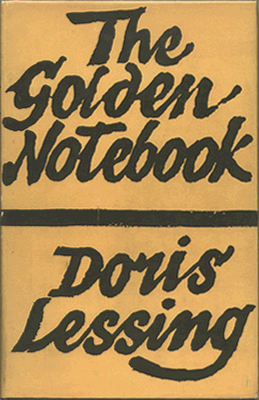
There's No Messing With Doris Lessing


I'm not likely to ever appear on Desert Island Discs, but of the three things they ask of you – seven records, one book and one luxury item – I think I'd have the greatest difficulty in deciding upon a single book to satisfy me for the rest of my days.

Doris Lessing's The Golden Notebook is exactly the sort of book to which you could dedicate a few lifetimes and still uncover fresh layers on subsequent reads.

Yes, this book is layered. But it's not layered like an onion – neat, even and stacked – it's layered like a scrunched up ball of paper – violent, overlapping and chaotic. Less than 100 pages in I understood that this – my initial reading – wouldn't be enough. Having finished it this afternoon I was gasping for breath. It's now been added to a pile – alongside James Joyce's Ulysses – of books that I'll need to read again at some point.

And that pile could act as a shortlist for the sort of books that I could happily take to a desert island, though I doubt that even a few decades in the sun would be enough to uncover all that could be uncovered. These aren't Desert Island Books. They're Eternity Books. Afterlife Books.

Like everything written at any point before today, The Golden Notebook is, in parts, a little dated. It's also utterly, horribly overwhelming. It's about so many things that it would be disingenuous to say that it's “about” any one thing, but it can be broadly summed up as an exhaustive exploration – in extreme close-up – of one woman's nervous breakdown, one thought at a time – over 576 demanding pages.

And in detailing this descent, it touches on so many themes that reading The Golden Notebook is like simultaneously reading five heavy novels at once in the back row of a particularly demanding socio-economic lecture.

Art, literature, identity, humanity, creativity, motherhood, communism, race, sex, gender, betrayal, writer's block – you can't describe this book without sounding like David Bowie describing his latest album.

I was very, very pleased to finish, because every single second spent with The Golden Notebook eventually felt unbearably heavy – just like, I imagine, would every single second spent with depression. I'm glad to have come out from the other side, but I don't regret, for one second, having picked up the book in the first place. Maybe I'll return to The Golden Notebook when I've more time on my hands, more experience under my belt and no tempting pristine copy of Gertrude Stein's Autobiography of Alice B. Toklas – freshly donated by a friend. But until then, I feel drained.


But what a wonderful, indispensable draining experience it was. Because Doris Lessing! This was my first exposure to Doris Lessing, but even if I just had the text of The Golden Notebook to go on, I'd already have enough evidence to suggest that even a word as magnificent as “genius” doesn't even begin to describe her.

Because bookending The Golden Notebook was an preface from Lessing – recently written – and an interview. On this initial exposure, I took much more from her non-fiction than I did her fiction, simply because her words and her ideas are nothing short of inspirational – perhaps even life-affirming.

I've been thinking a lot, recently, about the position of critics in our society. Do we need them at all? Probably not. But Lessing puts their role – their responsibilities – in a most intriguing light:

“...writers are looking in the critics for an alter ego, that other self more intelligent than oneself who has seen what one is reaching for, and who judges you only by whether you have matched up to your aim or not... But what he, the writer, is asking is impossible. Why should he expect this extraordinary being, the perfect critic (who does occasionally exist), why should there be anyone else who comprehends what he is trying to do? After all, there is only one person spinning that particular cocoon, only one person whose business it is to spin it...It is not possible for reviewers and critics to provide what they purport to provide – and for which writers so ridiculously and childishly yearn.”

So according to Lessing, critics have an unrealistic idea of their position in society, and writers have nobody but themselves to blame for this, for it was they who placed critics on their pedestal.

But it apparently goes further than this. Lessing believes that, from a very young age, we're conditioned – even brainwashed – to refuse to recognise the true value and intent of what we read.

“It starts when the child is as young as five or six, when he arrives at school. It starts with marks, rewards, “places”, “streams”, stars – and still in many places, stripes. This horserace mentality, the victor and loser way of thinking, leads to “Writer X is, is not, a few paces ahead or Writer Y. Writer Y has fallen behind. In his last book, Writer Z has shown himself to be better than Writer A.” From the very beginning, the child is trained to think in this way: always in terms of comparison, of success, and of failure.”


Lessing extrapolates political connotations from this – children are conditioned to respect authority, to not think for themselves – but when I read this I also applied it to every other kind of criticism – especially music criticism, the obtuse nature of which has given me so much gripe in recent years.

“These children who have spent years inside the training system become critics and reviewers, and cannot give what the author, the artist, so foolishly looks for – imaginative and original judgement. What they can do, and what they do very well, is to tell the writer how the book or play accords with current patterns of feeling and thinking – the climate of opinion.”


When I read that, I wanted to shout: “Ha! Take THAT, every critic with whom I've ever taken issue.” I wanted to reach through the page and give Doris a high five. 15 pages into my first ever exposure to the writing of Doris Lessing, and I already wanted to marry her.

Critics aren't nearly as important at they think they are – or as they want us to think they are. Instead, due to inherent weaknesses instilled from childhood, they are nothing more than, as Doris so brilliantly puts it, “litmus paper”. They're not arbiters of taste and opinion. They're products of taste and opinion – just like everyone else.

Critics – and writers too – could learn a thing or two from Doris. It seems that the relationship will always be codependent, but there's nothing stopping it from being healthier.

Less cynical and pessimistic – but infinitely more poignant – is the interview included at the end of my copy of The Golden Notebook. Asked if she stops reading other people's books when writing her own, she replies:

“ I have stopped with my current book, because my time is running out. I'm 87 [she's now 93], I'm not going to live forever and I want to finish this book I'm writing now. I'll go back to being a good reader when I finish it.”


Wow.

Finally, she offers a very good reason for good people - “boulder pushers”, as they're called by The Golden Notebook's protagonist – to remain optimistic. She's asked how living through “one of the most tumultuous centuries in our history” has affected her.

“Well, I've lived through Hitler, ranting and raving; Mussolini too; the Soviet Union, which we thought would last for all time; the British Empire, which seemed impregnable; the colour bar in Rhodesia and elsewhere; the heydey of European empires. It was inconceivable to think that these would disappear. They seemed permanent. Now not one of them remains – and I think that is a recipe for optimism!”


So to sum up, I think I'm in love with Doris Lessing.

Wrapped Up In Books


No friends, no money, no daylight. My first semester at university was terrible.

The closest thing I had to a social life were weekly meetings of the Warp and Megalomaniac societies, both of which were all-but filled with embittered third-years and mature students - hardly conducive to the wild and boundless hedonism that I had expected university to be. Warp was the science-fiction society, where no discussions of science-fiction ever took place. Instead we sat in a bar designed for mature students that was lit like a dentist's office and smelled a bit funny. Still. The jukebox was good.

The Megalomaniacs described themselves as “the political satire society”, and I think the only way you could have met a more unpleasant bunch of people would be had you attended a meeting of the University of Manchester Young Tories, Facists and Football Fans Society. Cynical by default, they never smiled, only sneered. They weren't all bad. Indeed, one of them would later help to secure victory for Manchester in University Challenge. But as a group they were set in their ways and about the exact opposite of the sort of people I wanted to meet.

No money – well. No student has much in the way of assets. But I was, for some reason, particularly poor – to the extent that I was surviving almost exclusively on a diet comprised of three staples – brown bread, crunchy peanut butter and Lidl's own-brand 8p instant noodles – with the odd pint of Fosters boosting my weekly calorie intake every time I did a load of laundry. I was very likely in a state of malnourishment – evidenced by the sores that appeared on my face, the cluster migraines I got at night (that would only intensify when I closed my eyes) and the fact that I blacked out when I went home for Christmas and ate some turkey and vegetables.

And no daylight. This was because my ground-floor room looked out onto a concrete parade ground that students often used as a football pitch. They had a tendency to stare into my room, so I took to shutting my curtains every time a game started. Eventually it got to the point where I wouldn't bother opening them again.

My first semester at university was terrible.

But I read a lot. It was, to all intents and purposes, all I had. Reading filled time. I had a lot of time to fill, and not much of it could be filled with studying. So I read and read and read – knowing, at the back of my mind, that I'd be at a genuine loss as to what to do with myself were I to run out of books to read. I was therefore really quite frightened of running out of books. It didn't bear thinking about.

Now that I've a lovely circle of friends and family, three more jobs than I deserve and plenty of sunlight, I don't have nearly so much time for reading – but I wouldn't have it any other way. But I find myself buying books all the time, to the extent that I've already acquired more books than I could possibly read in a lifetime.

Having such an immense backlog – combined with my tendency to compel myself to do a set amount of things in a set amount of time – has, I now realise, made me develop a less than ideal approach to reading. Rather than considering that I have the remainder of my natural life to devote to reading as many books as I want, I've found myself, on a few occasions, only reading a book for the sake of reading a book – so that it could be removed from the pile.

This is the exact opposite of the position I was in during that first terrible university semester. Back then I learned to appreciate the immense importance of books through convincing myself that, without them, I would die. These days I'm trying to recapture the ability to read one book at a time – and to grace that one book with every ounce of appreciation I'm willing to give it.

But still. It's nice to know that no matter how bad things should get, I will never, ever, ever run out of things to read – which is possibly about as close as you can possibly get to ensuring lifelong happiness.

At the very least, I'm never going to get bored.

So I'm here now, with an immense guilty groan of books next to me, most of which are just waiting - quite impatiently - to be read. I don't necessarily structure my reading habits, but I have certain rules. As a new year begins I find myself reading colourful genre fiction – possibly in reaction to the relentless drabness of that time of year. Over the summer, I want plot and I want as many pages as possible – the sort of story in which you can really lose yourself. Towards the end of October I'll turn to ghost stories, because who doesn't? As Autumn decays into winter I'll see through the change with some Victorian Gothic, and then, come Christmas, it's time for Dickens. I read one or two Dickens each year over the extended Christmas period, and I like to think that once I've finally read through his oeuvre, I'll simply read it all again. And again and again, until I die. Yeah!

Books are inexpensive, lovely to look at, lovely to hold, and whether they're ordered or cluttered, when you have a lot of them in your life your life feels more complete.

Books, then, are your friends for life. They even smell nice. Go hug a book now. NOW.

20130429

Ready Player One - It's Egg Hunting Season!


In little over a week, the whole Boards of Canada Easter Egg Hunt has progressed significantly. At the time of writing, we have five of the six numbers – but we're still no closer to discovering what it all means.

It turns out that The Record Store Day Incident (as it's now being called – how Fortean!) was just the kick-off. Whilst everyone initially thought that there'd be a different code on each of the six records (of which only four have apparently been found), instead it appears that each code will reveal itself in a different way.

First there was all the rigmarole on the band's YouTube channel. Since then, subsequent codes have been variously revealed through clever gif manipulation; through broadcasts on NPR and on Zane Lowe's Radio 1 show (number stations!) and, best of all, through the above advert that was broadcast on The Cartoon Network (of all places).

The most intriguing event, though, has been a projection on the building opposite London's Rough Trade store (where the second vinyl was found). The staff of the store claimed total ignorance. And, despite rumours circulating that the door of the building would open at midnight (for the first Boards of Canada gig since 2002?), very little came of this.


Still, it seemed to confirm not just the authenticity of this whole thing (as if there remained any doubters), but also the unbearably exciting notion that something's happening.

Unfortunately, despite the fact that my love for Boards of Canada runs through me like the lettering on Blackpool Rock, my part in this will only ever be as an observer. With a string of six numbers making up a 36 digit code, it's obvious that this will ultimately present a mathematical problem.

Reincarnation is a nice idea, and I like to think that, before you regenerate, you get to choose certain traits – like an RPG character creation screen. Well, if I'm given a second chance of life, above all I'd like to try my hands at being somebody with an inherent interest in science, technology and mathematics.

At the moment, though scientific and mathematical theories can pique my interest, I feel as though the very wiring of my brain prevents me from truly comprehending anything I read about – let alone from forming or applying any of my own theories.

It's always been like this. At school I pushed myself to get an A in GCSE Maths, but I was really only learning by rote exactly the information that would be required to pass that specific exam. I had no underlying understanding or appreciation of the information, and I promptly forgot pretty much everything I'd learned the second I finally put my pencil down at the end of the exam.

Still. I might not have developed a very scientific mind, but I think I've more than made up for that through my love of music, films, history, words, grammar and stories – by which I mean books.

So whilst I can't play an active part in the Boards of Canada Easter Egg Hunt, I can at least enjoy it as a bloody good story.

And as a bloody good story, it's particularly enjoyable because the whole thing reminds me of a bloody good story I read recently.


Ready Player One by Ernest Cline is a very popular book indeed. It's so popular, that people dress as it for Halloween. Not as characters from the book, mind, but as the book itself.

I don't think even Twilight elicited that level of devotion.

Ready Player One takes place in 2044. The world isn't quite a post-apocalyptic wasteland, but society and the economy appeared to have collapsed and things are quite awful. So most people spend their time inside a ridiculously immersive virtual reality environment called OASIS.

Designed by an obsessive savant called Halliday, I really wish that OASIS actually existed in real life. It's a seemingly infinite universe in which you can be whoever you want, do whatever you want and fully-explore the locations of pretty much any sci-fi or fantasy universe you could care to mention.

Before passing away, Halliday reveals that he's hidden an Easter Egg somewhere in OASIS, and whoever finds it will inherit his vast fortune. The novel details the exploits of a player called Parzival and his friends in their quest to track down this elusive egg.

As the novel goes, it's far from perfect. It's told in the first person – from Parzival's perspective – and it's implied that he's telling his story so that future generations will understand “what really happened”. But if that's the case, I've no idea why he feels the need to pepper his narrative with such excessive cultural-economic infodumps. It's fascinating for us early 21st century readers to get an insight into his world, but surely Parzival's intended audience would already be painfully familiar with the world he's describing? After all, they've never known any other.

The world-building, then, is clumsy at best, and the final “message” appears to undermine absolutely everything that's come before. But still, Ready Player One remains some of the best genre fiction I've read in recent years.

This is partly because it's so engaging. The idea that your obsessive knowledge of pop culture might save the world (a virtual world at that) is very appealing to anyone who likes films, music and video games as more than just part of a lifestyle.

But the most remarkable thing about Ready Player One is that everything Parzival achieves he does so under his own volition - using a combination of knowledge, intuition and incredible courage. Parzival is therefore a real hero, and a most refreshing change from the “chosen one” trope that still seems to dominate genre fiction.

Honestly, is there anything more boring than a meek hero who has greatness thrust upon him? I'm certainly had enough of that idea. From now on, I only want heroes who know what they're doing, know why they're doing it and, crucially, who want to do it.

Which is why Ready Player One is such an engaging, refreshing read. All this useless knowledge I've built up over the years? It might not always be useless.

So my lack of mathematical knowledge might force me to take a regretful back seat in this Boards of Canada Easter Egg Hunt. But you never know. One day, there might be something greater at stake – the fate of the world! - and it might depend on deep knowledge and appreciation of my specific interests.

But until then, hey! New Boards of Canada album!

Probably. All of this has to lead to something.

20130422

The Return Of Boards of Canada


It's funny, sometimes, how things pan out.

I was listening to The Conet Project. I'm still listening to The Conet Project – it's about 4.8 hours long. So far I've recognised numerous sequences from Boards of Canada songs. It seems that every time a sequence of numbers appears in their music, it's a Conet Project sample.

But anyway, just as this spark of familiarity flared, I noticed on my Twitter feed that Boards of Canada are back, and they're back in the best way possible.

It seems that New York's Other Music was visited by a representative from Warp Records at about 15.00 on Record Store Day. They dropped off a record – just one – a supremely cryptic dispatch from Boards of Canada. This record was bought almost instantly by a Reddit user.

On the sleeve were a series of dashes, slashes and Xs, arranged thus:

—— / —— / —— / XXXXXX / —— / ——

On the record were about twenty seconds of music (which sound like a riff on the ambient intro to Everything You Do Is A Balloon) and a sequence of numbers (making it even stranger that I should have been listening to The Conet Project when I learned about this).


The numbers are 936557.

All we have beyond that is an upload to Boards of Canada's official Youtube channel – a new video for Julie and Candy from Geogaddi, entitled “1977 snow computing amateur footage beards synthesizer”. It was originally labelled with a series of dashes, which appeared initially at the 4:20 mark of the video, then, on the next day, at the 4:19 mark.


Consequence of Sound believe that they might be counting down to something. If a new album's in the pipeline, this suggests that it might be out in less than 300 days!

This has made me extremely happy for two reasons. First of all, a new Boards of Canada album. Get in.

But second of all, how often has it been said that the internet's stripped all mystery and romanticism from music? I'm looking at you, Twitter. Now that we're prithee to the every thought of every musician, it does feel as though we've lost something.

Also, we can now hear (and criticise) albums months before they're released. We can sing every word of every unreleased song ever played at a gig.

That Boards of Canada can retain this esoteric edge even in these days when everybody knows everything all the time is wonderful. Truly wonderful.

What's more, they appear to be using the internet not to spread information, but to spread mystery. It's been reasoned that there are six of these records (as there are five more dashes on the front of the record), and presumably they've been placed in locations all over the world.

Boards of Canada attract the sort of fans who'll pore over every clue they're given in an attempt to uncover whatever mystery's waiting to be uncovered. In releasing this dispatch in this way, they're encouraging people to get together online in order to pick apart and piece together what little information we have.

Case in point? On the same Consequence of Sound article as linked to above, it's already been pointed out in the comments that the sequence of numbers – 936557 – correspond to a turquoise sort of colour.

The significance of that is enough to indue a sharp take of breath for any Boards of Canada fan.

So next time anybody complains that music's been ruined irreparably by the internet, point them in the direction of Boards of Canada. It takes a very special kind of band to spread so much hype through saying so little.

20130403

How To Overcome Writer's Block


Hey everyone, it's my 150th post!

So now it's perhaps time to address just what the hell is going on with this blog.

It started off as a music blog. Then it morphed into a film review blog. Over the years, I've also written about books, and why you shouldn't shop at Tesco.

I've also written about writing. And I think, ultimately, that's what it's all about.

I started this blog in 2009. Recently, it occurred to me that, since starting this blog, with very few exceptions I've spent at least an hour of each and every day just writing.

I've written many things. Blog posts. Articles. Emails. Letters. Poems. Songs. Reviews. Short stories. Long stories. Plays. Sketches. Sales copy. Static content. Briefs. Drafts. Redrafts. You name it. But scarcely a day has gone by without me dedicating even a short stretch of time to writing.

I've realised that this blog has been not just an outlet, but also a means of practising what I really want to do in life. I consider myself to be a writer, but I know that I still have at least a decade of fruitless plugging ahead of me before I truly have anything to show for my efforts. Therefore, as writers go, I am still in the “aspiring” category – and I will remain in this category for a good while yet. Perhaps the rest of my life!

So whilst I'm not yet in any position to offer advice to any aspiring writers, I can at least share my experiences. And one thing that seems obvious, even at this stage, is that it's a very good idea for any aspiring writer – whether their aspirations are in fiction, journalism or otherwise – to have a space like this – a place where they can be themselves – where they can find out what works and what doesn't work - with or without an audience.

It seems to me that aspiring writers in the 21st century have it much better than aspiring writers have ever had it before. Susan Sontag might have written realms of thoughts in her diaries, but during her formative years, nobody could ever tell her that she was brilliant, that she should absolutely keep doing what she's doing. However, people can actually swoop in and tell me that my sentences are too long. And then I have something I can work on. Something to address. The second sentence in the previous paragraph, for instance? Far too long! Thanks!

You never know. Perhaps if he'd been able to blog (or, indeed, to self-publish), John Kennedy Toole would still be with us. And, whilst Jonathan Franzen suspects that the internet is detrimental to good fiction, I'm finding the wisdom of the numerous “Advice For Writers” Twitter feeds I follow to be genuinely inspirational.

We have the internet. Have any other generations of new writers had such a vast wealth of advice and pointers at their disposal? Alright, it's somewhat ironic that every day I seem to read the old “writing is 3% talent and 97% not being distracted by the internet” nugget. But still, that the biggest obstacle for aspiring writers to overcome in the 21st century is distraction and procrastination suggests we have it quite good.

Like I say, my comparative lack of success and experience when it comes to writing means that I'm not exactly qualified to dish out any advice, but I have been doing this non-stop for some years now. And it struck me the other day – in my four years or so of uninterrupted and diverse writing, not once have I suffered from serious writer's block.

Yes, I've had long periods of crippling, debilitating doubt. Indeed, I'm having one right now! But it's seldom been the case that I've actively struggled to get the words out.

So don't think of this as “advice”. Think of it as something that's always worked for me.


I don't think of writer's block as a dearth of ideas. The Oatmeal recently did a truly inspirational piece on the creative lifestyle in which creativity was likened not to a lake, but to a river. Your ideas aren't a finite pool that'll ultimately be depleted. Rather, they're a raging and chaotic torrent, the richness of which depends upon the richness of your life, your relationships and your reading.

So if you were truly meant to pursue this path, your writer's block does not signify that your pool of ideas is in danger of running dry. Instead, I've come to recognise it as nothing more than a highly specific fear. It's not necessarily a fear of failure, though that does come into it. However, any such fears are symptoms, not causes, of writer's block. As I understand it, it all boils down to a very basic wariness of the blank page.

Any difficulty I have with writing is with starting or continuing a project. Once I get going I can write uninterrupted for hours. But it's in achieving this desired flow that I have problems, and the problems seem at their most insurmountable when I'm confronting a blank page.

Yet this can be overcome in a matter of seconds. The moment – the very moment – that anything's down on the page, I'm fine. Even if it's just a word, a sentence, or a random stream of characters, it's enough to get me started. So many of my finished stories, articles, blog posts etc. have started life as something utterly nonsensical. Something like fdsjgjlbndaoigjk rw. Anything to make footprints in the terrifying white expanse of nothingness. Even gibberish can act as a great starting point – a nonsensical block of wood to be whittled into something resembling a word or sentence – the forceful kick to the ancient engine that sets the old Russian satellite back on track.

Neil Gaiman's contribution to the noble lineage of advice from writers simply boils down to “keep writing”. If, God willing, I'm ever in a position to offer my two cents, my contribution to the rich tradition of writing advice will probably be “start writing”. The moment anything's down, you're off. Keep going, and don't look back until you're done.

Picking up the thread where you left off is sometimes even harder, but the remedy's much simpler. All you have to do is ensure that you stop your daily writing in the middle of a sentence. That's it. It works! You can then pick up exactly where you left things when you next sit down to create.

Yep, my words are currently meaningless as I've not really had much success in that field. But that's why you have to keep writing.

Right Neil?

Thanks Neil.

We have it so good. We can follow Neil Gaiman on Twitter!