20130501

There's No Messing With Doris Lessing


I'm not likely to ever appear on Desert Island Discs, but of the three things they ask of you – seven records, one book and one luxury item – I think I'd have the greatest difficulty in deciding upon a single book to satisfy me for the rest of my days.

Doris Lessing's The Golden Notebook is exactly the sort of book to which you could dedicate a few lifetimes and still uncover fresh layers on subsequent reads.

Yes, this book is layered. But it's not layered like an onion – neat, even and stacked – it's layered like a scrunched up ball of paper – violent, overlapping and chaotic. Less than 100 pages in I understood that this – my initial reading – wouldn't be enough. Having finished it this afternoon I was gasping for breath. It's now been added to a pile – alongside James Joyce's Ulysses – of books that I'll need to read again at some point.

And that pile could act as a shortlist for the sort of books that I could happily take to a desert island, though I doubt that even a few decades in the sun would be enough to uncover all that could be uncovered. These aren't Desert Island Books. They're Eternity Books. Afterlife Books.

Like everything written at any point before today, The Golden Notebook is, in parts, a little dated. It's also utterly, horribly overwhelming. It's about so many things that it would be disingenuous to say that it's “about” any one thing, but it can be broadly summed up as an exhaustive exploration – in extreme close-up – of one woman's nervous breakdown, one thought at a time – over 576 demanding pages.

And in detailing this descent, it touches on so many themes that reading The Golden Notebook is like simultaneously reading five heavy novels at once in the back row of a particularly demanding socio-economic lecture.

Art, literature, identity, humanity, creativity, motherhood, communism, race, sex, gender, betrayal, writer's block – you can't describe this book without sounding like David Bowie describing his latest album.

I was very, very pleased to finish, because every single second spent with The Golden Notebook eventually felt unbearably heavy – just like, I imagine, would every single second spent with depression. I'm glad to have come out from the other side, but I don't regret, for one second, having picked up the book in the first place. Maybe I'll return to The Golden Notebook when I've more time on my hands, more experience under my belt and no tempting pristine copy of Gertrude Stein's Autobiography of Alice B. Toklas – freshly donated by a friend. But until then, I feel drained.
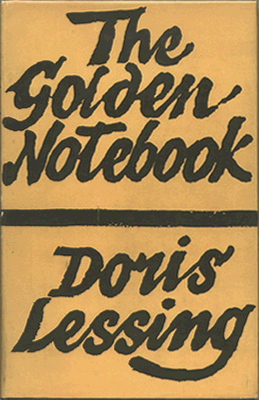


But what a wonderful, indispensable draining experience it was. Because Doris Lessing! This was my first exposure to Doris Lessing, but even if I just had the text of The Golden Notebook to go on, I'd already have enough evidence to suggest that even a word as magnificent as “genius” doesn't even begin to describe her.

Because bookending The Golden Notebook was an preface from Lessing – recently written – and an interview. On this initial exposure, I took much more from her non-fiction than I did her fiction, simply because her words and her ideas are nothing short of inspirational – perhaps even life-affirming.

I've been thinking a lot, recently, about the position of critics in our society. Do we need them at all? Probably not. But Lessing puts their role – their responsibilities – in a most intriguing light:

“...writers are looking in the critics for an alter ego, that other self more intelligent than oneself who has seen what one is reaching for, and who judges you only by whether you have matched up to your aim or not... But what he, the writer, is asking is impossible. Why should he expect this extraordinary being, the perfect critic (who does occasionally exist), why should there be anyone else who comprehends what he is trying to do? After all, there is only one person spinning that particular cocoon, only one person whose business it is to spin it...It is not possible for reviewers and critics to provide what they purport to provide – and for which writers so ridiculously and childishly yearn.”

So according to Lessing, critics have an unrealistic idea of their position in society, and writers have nobody but themselves to blame for this, for it was they who placed critics on their pedestal.

But it apparently goes further than this. Lessing believes that, from a very young age, we're conditioned – even brainwashed – to refuse to recognise the true value and intent of what we read.

“It starts when the child is as young as five or six, when he arrives at school. It starts with marks, rewards, “places”, “streams”, stars – and still in many places, stripes. This horserace mentality, the victor and loser way of thinking, leads to “Writer X is, is not, a few paces ahead or Writer Y. Writer Y has fallen behind. In his last book, Writer Z has shown himself to be better than Writer A.” From the very beginning, the child is trained to think in this way: always in terms of comparison, of success, and of failure.”


Lessing extrapolates political connotations from this – children are conditioned to respect authority, to not think for themselves – but when I read this I also applied it to every other kind of criticism – especially music criticism, the obtuse nature of which has given me so much gripe in recent years.

“These children who have spent years inside the training system become critics and reviewers, and cannot give what the author, the artist, so foolishly looks for – imaginative and original judgement. What they can do, and what they do very well, is to tell the writer how the book or play accords with current patterns of feeling and thinking – the climate of opinion.”


When I read that, I wanted to shout: “Ha! Take THAT, every critic with whom I've ever taken issue.” I wanted to reach through the page and give Doris a high five. 15 pages into my first ever exposure to the writing of Doris Lessing, and I already wanted to marry her.

Critics aren't nearly as important at they think they are – or as they want us to think they are. Instead, due to inherent weaknesses instilled from childhood, they are nothing more than, as Doris so brilliantly puts it, “litmus paper”. They're not arbiters of taste and opinion. They're products of taste and opinion – just like everyone else.

Critics – and writers too – could learn a thing or two from Doris. It seems that the relationship will always be codependent, but there's nothing stopping it from being healthier.

Less cynical and pessimistic – but infinitely more poignant – is the interview included at the end of my copy of The Golden Notebook. Asked if she stops reading other people's books when writing her own, she replies:

“ I have stopped with my current book, because my time is running out. I'm 87 [she's now 93], I'm not going to live forever and I want to finish this book I'm writing now. I'll go back to being a good reader when I finish it.”


Wow.

Finally, she offers a very good reason for good people - “boulder pushers”, as they're called by The Golden Notebook's protagonist – to remain optimistic. She's asked how living through “one of the most tumultuous centuries in our history” has affected her.

“Well, I've lived through Hitler, ranting and raving; Mussolini too; the Soviet Union, which we thought would last for all time; the British Empire, which seemed impregnable; the colour bar in Rhodesia and elsewhere; the heydey of European empires. It was inconceivable to think that these would disappear. They seemed permanent. Now not one of them remains – and I think that is a recipe for optimism!”


So to sum up, I think I'm in love with Doris Lessing.

Wrapped Up In Books


No friends, no money, no daylight. My first semester at university was terrible.

The closest thing I had to a social life were weekly meetings of the Warp and Megalomaniac societies, both of which were all-but filled with embittered third-years and mature students - hardly conducive to the wild and boundless hedonism that I had expected university to be. Warp was the science-fiction society, where no discussions of science-fiction ever took place. Instead we sat in a bar designed for mature students that was lit like a dentist's office and smelled a bit funny. Still. The jukebox was good.

The Megalomaniacs described themselves as “the political satire society”, and I think the only way you could have met a more unpleasant bunch of people would be had you attended a meeting of the University of Manchester Young Tories, Facists and Football Fans Society. Cynical by default, they never smiled, only sneered. They weren't all bad. Indeed, one of them would later help to secure victory for Manchester in University Challenge. But as a group they were set in their ways and about the exact opposite of the sort of people I wanted to meet.

No money – well. No student has much in the way of assets. But I was, for some reason, particularly poor – to the extent that I was surviving almost exclusively on a diet comprised of three staples – brown bread, crunchy peanut butter and Lidl's own-brand 8p instant noodles – with the odd pint of Fosters boosting my weekly calorie intake every time I did a load of laundry. I was very likely in a state of malnourishment – evidenced by the sores that appeared on my face, the cluster migraines I got at night (that would only intensify when I closed my eyes) and the fact that I blacked out when I went home for Christmas and ate some turkey and vegetables.

And no daylight. This was because my ground-floor room looked out onto a concrete parade ground that students often used as a football pitch. They had a tendency to stare into my room, so I took to shutting my curtains every time a game started. Eventually it got to the point where I wouldn't bother opening them again.

My first semester at university was terrible.

But I read a lot. It was, to all intents and purposes, all I had. Reading filled time. I had a lot of time to fill, and not much of it could be filled with studying. So I read and read and read – knowing, at the back of my mind, that I'd be at a genuine loss as to what to do with myself were I to run out of books to read. I was therefore really quite frightened of running out of books. It didn't bear thinking about.

Now that I've a lovely circle of friends and family, three more jobs than I deserve and plenty of sunlight, I don't have nearly so much time for reading – but I wouldn't have it any other way. But I find myself buying books all the time, to the extent that I've already acquired more books than I could possibly read in a lifetime.

Having such an immense backlog – combined with my tendency to compel myself to do a set amount of things in a set amount of time – has, I now realise, made me develop a less than ideal approach to reading. Rather than considering that I have the remainder of my natural life to devote to reading as many books as I want, I've found myself, on a few occasions, only reading a book for the sake of reading a book – so that it could be removed from the pile.

This is the exact opposite of the position I was in during that first terrible university semester. Back then I learned to appreciate the immense importance of books through convincing myself that, without them, I would die. These days I'm trying to recapture the ability to read one book at a time – and to grace that one book with every ounce of appreciation I'm willing to give it.

But still. It's nice to know that no matter how bad things should get, I will never, ever, ever run out of things to read – which is possibly about as close as you can possibly get to ensuring lifelong happiness.

At the very least, I'm never going to get bored.

So I'm here now, with an immense guilty groan of books next to me, most of which are just waiting - quite impatiently - to be read. I don't necessarily structure my reading habits, but I have certain rules. As a new year begins I find myself reading colourful genre fiction – possibly in reaction to the relentless drabness of that time of year. Over the summer, I want plot and I want as many pages as possible – the sort of story in which you can really lose yourself. Towards the end of October I'll turn to ghost stories, because who doesn't? As Autumn decays into winter I'll see through the change with some Victorian Gothic, and then, come Christmas, it's time for Dickens. I read one or two Dickens each year over the extended Christmas period, and I like to think that once I've finally read through his oeuvre, I'll simply read it all again. And again and again, until I die. Yeah!

Books are inexpensive, lovely to look at, lovely to hold, and whether they're ordered or cluttered, when you have a lot of them in your life your life feels more complete.

Books, then, are your friends for life. They even smell nice. Go hug a book now. NOW.

20130429

Ready Player One - It's Egg Hunting Season!


In little over a week, the whole Boards of Canada Easter Egg Hunt has progressed significantly. At the time of writing, we have five of the six numbers – but we're still no closer to discovering what it all means.

It turns out that The Record Store Day Incident (as it's now being called – how Fortean!) was just the kick-off. Whilst everyone initially thought that there'd be a different code on each of the six records (of which only four have apparently been found), instead it appears that each code will reveal itself in a different way.

First there was all the rigmarole on the band's YouTube channel. Since then, subsequent codes have been variously revealed through clever gif manipulation; through broadcasts on NPR and on Zane Lowe's Radio 1 show (number stations!) and, best of all, through the above advert that was broadcast on The Cartoon Network (of all places).

The most intriguing event, though, has been a projection on the building opposite London's Rough Trade store (where the second vinyl was found). The staff of the store claimed total ignorance. And, despite rumours circulating that the door of the building would open at midnight (for the first Boards of Canada gig since 2002?), very little came of this.


Still, it seemed to confirm not just the authenticity of this whole thing (as if there remained any doubters), but also the unbearably exciting notion that something's happening.

Unfortunately, despite the fact that my love for Boards of Canada runs through me like the lettering on Blackpool Rock, my part in this will only ever be as an observer. With a string of six numbers making up a 36 digit code, it's obvious that this will ultimately present a mathematical problem.

Reincarnation is a nice idea, and I like to think that, before you regenerate, you get to choose certain traits – like an RPG character creation screen. Well, if I'm given a second chance of life, above all I'd like to try my hands at being somebody with an inherent interest in science, technology and mathematics.

At the moment, though scientific and mathematical theories can pique my interest, I feel as though the very wiring of my brain prevents me from truly comprehending anything I read about – let alone from forming or applying any of my own theories.

It's always been like this. At school I pushed myself to get an A in GCSE Maths, but I was really only learning by rote exactly the information that would be required to pass that specific exam. I had no underlying understanding or appreciation of the information, and I promptly forgot pretty much everything I'd learned the second I finally put my pencil down at the end of the exam.

Still. I might not have developed a very scientific mind, but I think I've more than made up for that through my love of music, films, history, words, grammar and stories – by which I mean books.

So whilst I can't play an active part in the Boards of Canada Easter Egg Hunt, I can at least enjoy it as a bloody good story.

And as a bloody good story, it's particularly enjoyable because the whole thing reminds me of a bloody good story I read recently.


Ready Player One by Ernest Cline is a very popular book indeed. It's so popular, that people dress as it for Halloween. Not as characters from the book, mind, but as the book itself.

I don't think even Twilight elicited that level of devotion.

Ready Player One takes place in 2044. The world isn't quite a post-apocalyptic wasteland, but society and the economy appeared to have collapsed and things are quite awful. So most people spend their time inside a ridiculously immersive virtual reality environment called OASIS.

Designed by an obsessive savant called Halliday, I really wish that OASIS actually existed in real life. It's a seemingly infinite universe in which you can be whoever you want, do whatever you want and fully-explore the locations of pretty much any sci-fi or fantasy universe you could care to mention.

Before passing away, Halliday reveals that he's hidden an Easter Egg somewhere in OASIS, and whoever finds it will inherit his vast fortune. The novel details the exploits of a player called Parzival and his friends in their quest to track down this elusive egg.

As the novel goes, it's far from perfect. It's told in the first person – from Parzival's perspective – and it's implied that he's telling his story so that future generations will understand “what really happened”. But if that's the case, I've no idea why he feels the need to pepper his narrative with such excessive cultural-economic infodumps. It's fascinating for us early 21st century readers to get an insight into his world, but surely Parzival's intended audience would already be painfully familiar with the world he's describing? After all, they've never known any other.

The world-building, then, is clumsy at best, and the final “message” appears to undermine absolutely everything that's come before. But still, Ready Player One remains some of the best genre fiction I've read in recent years.

This is partly because it's so engaging. The idea that your obsessive knowledge of pop culture might save the world (a virtual world at that) is very appealing to anyone who likes films, music and video games as more than just part of a lifestyle.

But the most remarkable thing about Ready Player One is that everything Parzival achieves he does so under his own volition - using a combination of knowledge, intuition and incredible courage. Parzival is therefore a real hero, and a most refreshing change from the “chosen one” trope that still seems to dominate genre fiction.

Honestly, is there anything more boring than a meek hero who has greatness thrust upon him? I'm certainly had enough of that idea. From now on, I only want heroes who know what they're doing, know why they're doing it and, crucially, who want to do it.

Which is why Ready Player One is such an engaging, refreshing read. All this useless knowledge I've built up over the years? It might not always be useless.

So my lack of mathematical knowledge might force me to take a regretful back seat in this Boards of Canada Easter Egg Hunt. But you never know. One day, there might be something greater at stake – the fate of the world! - and it might depend on deep knowledge and appreciation of my specific interests.

But until then, hey! New Boards of Canada album!

Probably. All of this has to lead to something.

20130422

The Return Of Boards of Canada


It's funny, sometimes, how things pan out.

I was listening to The Conet Project. I'm still listening to The Conet Project – it's about 4.8 hours long. So far I've recognised numerous sequences from Boards of Canada songs. It seems that every time a sequence of numbers appears in their music, it's a Conet Project sample.

But anyway, just as this spark of familiarity flared, I noticed on my Twitter feed that Boards of Canada are back, and they're back in the best way possible.

It seems that New York's Other Music was visited by a representative from Warp Records at about 15.00 on Record Store Day. They dropped off a record – just one – a supremely cryptic dispatch from Boards of Canada. This record was bought almost instantly by a Reddit user.

On the sleeve were a series of dashes, slashes and Xs, arranged thus:

—— / —— / —— / XXXXXX / —— / ——

On the record were about twenty seconds of music (which sound like a riff on the ambient intro to Everything You Do Is A Balloon) and a sequence of numbers (making it even stranger that I should have been listening to The Conet Project when I learned about this).


The numbers are 936557.

All we have beyond that is an upload to Boards of Canada's official Youtube channel – a new video for Julie and Candy from Geogaddi, entitled “1977 snow computing amateur footage beards synthesizer”. It was originally labelled with a series of dashes, which appeared initially at the 4:20 mark of the video, then, on the next day, at the 4:19 mark.


Consequence of Sound believe that they might be counting down to something. If a new album's in the pipeline, this suggests that it might be out in less than 300 days!

This has made me extremely happy for two reasons. First of all, a new Boards of Canada album. Get in.

But second of all, how often has it been said that the internet's stripped all mystery and romanticism from music? I'm looking at you, Twitter. Now that we're prithee to the every thought of every musician, it does feel as though we've lost something.

Also, we can now hear (and criticise) albums months before they're released. We can sing every word of every unreleased song ever played at a gig.

That Boards of Canada can retain this esoteric edge even in these days when everybody knows everything all the time is wonderful. Truly wonderful.

What's more, they appear to be using the internet not to spread information, but to spread mystery. It's been reasoned that there are six of these records (as there are five more dashes on the front of the record), and presumably they've been placed in locations all over the world.

Boards of Canada attract the sort of fans who'll pore over every clue they're given in an attempt to uncover whatever mystery's waiting to be uncovered. In releasing this dispatch in this way, they're encouraging people to get together online in order to pick apart and piece together what little information we have.

Case in point? On the same Consequence of Sound article as linked to above, it's already been pointed out in the comments that the sequence of numbers – 936557 – correspond to a turquoise sort of colour.

The significance of that is enough to indue a sharp take of breath for any Boards of Canada fan.

So next time anybody complains that music's been ruined irreparably by the internet, point them in the direction of Boards of Canada. It takes a very special kind of band to spread so much hype through saying so little.

20130403

How To Overcome Writer's Block


Hey everyone, it's my 150th post!

So now it's perhaps time to address just what the hell is going on with this blog.

It started off as a music blog. Then it morphed into a film review blog. Over the years, I've also written about books, and why you shouldn't shop at Tesco.

I've also written about writing. And I think, ultimately, that's what it's all about.

I started this blog in 2009. Recently, it occurred to me that, since starting this blog, with very few exceptions I've spent at least an hour of each and every day just writing.

I've written many things. Blog posts. Articles. Emails. Letters. Poems. Songs. Reviews. Short stories. Long stories. Plays. Sketches. Sales copy. Static content. Briefs. Drafts. Redrafts. You name it. But scarcely a day has gone by without me dedicating even a short stretch of time to writing.

I've realised that this blog has been not just an outlet, but also a means of practising what I really want to do in life. I consider myself to be a writer, but I know that I still have at least a decade of fruitless plugging ahead of me before I truly have anything to show for my efforts. Therefore, as writers go, I am still in the “aspiring” category – and I will remain in this category for a good while yet. Perhaps the rest of my life!

So whilst I'm not yet in any position to offer advice to any aspiring writers, I can at least share my experiences. And one thing that seems obvious, even at this stage, is that it's a very good idea for any aspiring writer – whether their aspirations are in fiction, journalism or otherwise – to have a space like this – a place where they can be themselves – where they can find out what works and what doesn't work - with or without an audience.

It seems to me that aspiring writers in the 21st century have it much better than aspiring writers have ever had it before. Susan Sontag might have written realms of thoughts in her diaries, but during her formative years, nobody could ever tell her that she was brilliant, that she should absolutely keep doing what she's doing. However, people can actually swoop in and tell me that my sentences are too long. And then I have something I can work on. Something to address. The second sentence in the previous paragraph, for instance? Far too long! Thanks!

You never know. Perhaps if he'd been able to blog (or, indeed, to self-publish), John Kennedy Toole would still be with us. And, whilst Jonathan Franzen suspects that the internet is detrimental to good fiction, I'm finding the wisdom of the numerous “Advice For Writers” Twitter feeds I follow to be genuinely inspirational.

We have the internet. Have any other generations of new writers had such a vast wealth of advice and pointers at their disposal? Alright, it's somewhat ironic that every day I seem to read the old “writing is 3% talent and 97% not being distracted by the internet” nugget. But still, that the biggest obstacle for aspiring writers to overcome in the 21st century is distraction and procrastination suggests we have it quite good.

Like I say, my comparative lack of success and experience when it comes to writing means that I'm not exactly qualified to dish out any advice, but I have been doing this non-stop for some years now. And it struck me the other day – in my four years or so of uninterrupted and diverse writing, not once have I suffered from serious writer's block.

Yes, I've had long periods of crippling, debilitating doubt. Indeed, I'm having one right now! But it's seldom been the case that I've actively struggled to get the words out.

So don't think of this as “advice”. Think of it as something that's always worked for me.


I don't think of writer's block as a dearth of ideas. The Oatmeal recently did a truly inspirational piece on the creative lifestyle in which creativity was likened not to a lake, but to a river. Your ideas aren't a finite pool that'll ultimately be depleted. Rather, they're a raging and chaotic torrent, the richness of which depends upon the richness of your life, your relationships and your reading.

So if you were truly meant to pursue this path, your writer's block does not signify that your pool of ideas is in danger of running dry. Instead, I've come to recognise it as nothing more than a highly specific fear. It's not necessarily a fear of failure, though that does come into it. However, any such fears are symptoms, not causes, of writer's block. As I understand it, it all boils down to a very basic wariness of the blank page.

Any difficulty I have with writing is with starting or continuing a project. Once I get going I can write uninterrupted for hours. But it's in achieving this desired flow that I have problems, and the problems seem at their most insurmountable when I'm confronting a blank page.

Yet this can be overcome in a matter of seconds. The moment – the very moment – that anything's down on the page, I'm fine. Even if it's just a word, a sentence, or a random stream of characters, it's enough to get me started. So many of my finished stories, articles, blog posts etc. have started life as something utterly nonsensical. Something like fdsjgjlbndaoigjk rw. Anything to make footprints in the terrifying white expanse of nothingness. Even gibberish can act as a great starting point – a nonsensical block of wood to be whittled into something resembling a word or sentence – the forceful kick to the ancient engine that sets the old Russian satellite back on track.

Neil Gaiman's contribution to the noble lineage of advice from writers simply boils down to “keep writing”. If, God willing, I'm ever in a position to offer my two cents, my contribution to the rich tradition of writing advice will probably be “start writing”. The moment anything's down, you're off. Keep going, and don't look back until you're done.

Picking up the thread where you left off is sometimes even harder, but the remedy's much simpler. All you have to do is ensure that you stop your daily writing in the middle of a sentence. That's it. It works! You can then pick up exactly where you left things when you next sit down to create.

Yep, my words are currently meaningless as I've not really had much success in that field. But that's why you have to keep writing.

Right Neil?

Thanks Neil.

We have it so good. We can follow Neil Gaiman on Twitter!

20130327

My Least Favourite Thing About Twitter


It's revealed just how petty I am.

I love Twitter. I'm not one of those who dismisses it as a place where idiots waste countless precious hours – though I am an idiot and I do waste countless precious hours there. But I'm not deluded enough to think that all those celebrities I follow actually care about my existence – though I was shamefully proud when the great Robert Florence replied to one of my tweets (even though his reply was essentially dismissive and consisted of just five words).

But though I'm quick to latch onto the tweets of anyone I vaguely admire like some kind of demanding, entitled limpet, I'm equally quick to unfollow even my most beloved of individuals the second they say anything with which I disagree.

I unfollowed childhood hero Michael Rosen when he said something mean about HMV. He laughed at all the “crocodile tears” being shed over its closure. No, I thought. That's a lot of people out of work and it's now utterly impossible to buy new music anywhere on the high streets of so many UK cities. Goodbye, Michael.

I unfollowed Pete Fowler – responsible for some of the best album covers of the past 20 years – after he made a few unsavoury comments about Alt-J. Alt-J made one of my favourite albums of last year, and I really don't care that Pete Fowler didn't care for it. But he was actively wishing death upon them and doing so apropos of nothing. Goodbye, Pete.

I unfollowed Luke Haines – songwriting genius – after I realised that all he ever did was sneer that music's not as good as it used to be. I know he's a celebrated misanthrope, but what sort of moron openly revels in the notion that rock music might be dead or dying? Goodbye, Luke.

Unforgivable on my part, though, is that I unfollowed Tom Cox after he said something nasty about Blur during their 2012 Brit Awards performance. Tom Cox wears tweed, is bearded, lives in Norfolk and writes witty and captivating articles and books about cats, folk customs and nature. He and I would undoubtedly be the best of friends if we met in real life. But all it took was a subtle suggestion that Pulp are better than Blur, and that was it. Goodbye, Tom.

I would much rather have not learned that about myself – that I'm so unwilling to expose myself to opinions that are even slightly different to mine. I like to think that I'm reasonable, open-minded and mature. But the second someone says something at all disagreeable? Whoosh – it's playground politics.

Still. It's one thing to simply unfollow those I admire before thinking ever so slightly less of them. At least I'm not painstakingly and obsessively documenting everything I hate about the world whilst ostensibly compiling a list of the 100 Worst People On Twitter.

The 100 Worst People On Twitter must be one of the worst websites to ever have existed. And in making that assessment, I include any right-wing atrocity or bad-porn ring you could care to mention. The world is a sad, horrible and merciless place as is. It's almost unbearably depressing that there are some people out there who seem to think: “Hey, you know what this world needs? More negativity!”

This is cynicism for the sake of cynicism. They claim to be looking out for those that “represent something bad beyond their Twitter account. The insularity of the British media classes. The sinister creep of threatened masculinity. The banality of modern alternative culture.” But I know this not to be the case.

How do I know this? Well, there are two people on the list who I really quite admire. Let's look at Charlie Brooker first. His writing is fresh, imaginative and energising – especially when he tries his hand at fiction. I can, however, fully understand a lot of the criticism he gets.

The 100 Worst People On Twitter, though, attack him on the grounds that he had Shoreditch hipster Nathan Barley listen to Supergrass.

Meanwhile, their no-holds-barred denouement of David Mitchell opens with this curious sentiment:

“The obvious point to make with David Mitchell is that he, Webb, and commisioning editors made the mistake of thinking that being able to memorise some words on a piece of paper and repeat them, sometimes while pretending to do things, meant that was enough to make you destined for greatness in the field of writing, because the words they read happened to be funny.”

Sorry, every actor that ever lived. But your ancient craft is nothing more than “being able to memorise some words on a piece of paper and repeat them, sometimes while pretending to do things”. That's all you're doing. So stop pretending you're talented. Because according to the good people of the 100 Worst People On Twitter – who, as you know, are the sole arbiters of acceptable behaviour – you're essentially worthless.

OK, these are two people I admire, so perhaps I'm naturally defensive. That I'm familiar with their work, though, means that I'm able to identify where these guys have just cherry-picked irrelevant and unrepresentative nuggets from extensive careers to support the thesis that Mitchell and Brooker don't really deserve to live.

It stands to reason that if they've taken this cherry-picking approach with these two, then they must have done with everyone. Which means that the roastings of those celebrities who I actively unhealthily dislike must be equally as ill-informed and vindictive.

But the worst thing about The 100 Worst People On Twitter is the sheer hypocrisy of those who compile it.

The introduction to their piece on David Mitchell suggests that they have no time or respect for actors or acting. Similarly, their piece on Charlie Brooker makes explicit their contempt for video games, for people who like video games and for people who write about video games.

But oh, heaven help those who have anything bad to say about hip hop!

According to these guys, if you don't like hip hop, you're definitely racist. Oh yes.

If you disagree with me, you're essentially evil. Now that's petty.

The amount of energy, research, redrafting and resentment that must have gone into writing much of what's on The 100 Worst People On Twitter genuinely makes me despair. Why would such conscientious individuals – such obviously talented writers – put so much effort into something that will only ever be used by people to justify their vindictive hatred?

One of the worst effects the internet's had upon creative types is that it seems to have kickstarted a tendency to sneer at the worst of everything (as opposed to seeking out and celebrating the best).

If you're looking for the worst humanity has to offer, you'll doubtlessly find it on Twitter.

But even if you're not seeking outrage, Twitter can disappoint you. How horrible it is to learn that those who you admire don't agree with you 100% of the time!

And that's my least favourite thing about Twitter. It's like a terrible funhouse mirror that makes humanity look much uglier than it really is.

The revelation that I'm so petty is just the start of it.

20130311

Making A Cup Of Tea For Everyone In Belgium & Other Heartwarming Scrapes

In the first decade of the noughties writers everywhere were apparently struck by a desire to have a wacky adventure that just so happened to involve a lot of tax-deductible travel. It resulted in a strange sub-genre of personal quest/travelogue books that to this day dominate charity shops and the humour section of Waterstones.

The adventure was often passed-off as a silly bet, and it invariably transformed into a journey of self discovery. The results were mixed. In some cases you got a genuinely engaging and often hilarious travelogue of intrigue. Mostly, though, you got the literary equivalent of JP from Fresh Meat – droning on about his gap year whilst describing everything as “literally well-random”.

Dave Gorman is the first name that comes to mind. With his Googlewhack Adventure, America Unchained and Are You Dave Gorman? books, he certainly struck upon some truly original ideas. His work is let down, though, by a tendency to take himself – and his self-imposed projects – far too seriously. Each of his books at some point spirals into a really quite terrifying meltdown. You want to reach through the page and say, “Dave, maybe you should calm down a little?”

If Dave Gorman took things too seriously, Tony Hawks had exactly the opposite problem. He travelled Round Ireland With A Fridge, played The Moldovians at Tennis and tried to have a number one single in any country, anywhere. Tony Hawks is a mild-mannered and mildly-spoken man who you might remember best as the “host” of Better Than Life on Red Dwarf, or as the uptight rapper behind The Stutter Rap. His books, though, were painfully obvious attempts to highlight just how quirky he believes himself to be. I gave up after A Piano In The Pyrenees, in which he struggled to wrest anything approaching humour from his relocation to the French mountains.

Then there's Tim Moore, who is funny. Really funny. What sets Tim Moore apart is that, like Bill Bryson (whose travel writing arguably inspired this curious sub-genre), his books are less self-consciously “wacky” projects that happen to involve a lot of travel and more straight-laced travel writing that just so happens to be utterly hilarious. Tim Moore drew comedy not from an absurd situation or idea, but from wry observations about the perfectly normal world around him. He's not a man that places himself in strange situations and begs you to laugh. He's a skilled comedian with a subtle delivery, excellent timing and an impeccable eye for detail. Moments from Frost On My Moustache, French Revolutions, Spanish Steps and Continental Drift are amongst the funniest scenes I've ever encountered in any medium.

So what would you call this sub-genre? The Humorous Travelogue? The Personal Project (With Hilarious Consequences)? The Comedic Wanderer? I don't know, but I was quite sure that the genre had exhausted its potential, and I was convinced that I'd exhausted all the enjoyment that could possibly be drawn from the writings of grown men with too much time on their hands who really should know better.

But then I read The Know-It-All by A.J. Jacobs.


An American journalist and editor of Esquire, A.J. Jacobs endeavoured to read the entire 2002 Encyclopaedia Britannia back-to-back. The Know-It-All is a document of his efforts, and it really is a lot funnier than a literary marathon has any right to be. More than that, it's frequently fascinating, often touching, sometimes sad and shocking and, ultimately, it could even be described as life-affirming.

In reading The Know-It-All, not only did I learn a lot of lethal facts for future deployment, I believe I also stumbled across exactly the reason why so many efforts by Dave Gorman and Tony Hawks failed in their efforts to amuse and engage. Their ideas might have been variously wacky and fascinating, but all too often they approached their projects with a sneer and a smirk. The books can therefore come across as so cynical as to be alienating. It's like they're saying “I know it's stupid, but you're the one who bought this book, aren't you? Have you any idea how rich this made me? And I got to go to China, too. Joke's on you, moron.”

Jacobs, though, seems perfectly aware of his limitations, and doesn't ever shy from sharing his shortcomings or anxieties. At no point does he present himself as the noble or begrudging hero caught up in something beyond or below him. And when his self-imposed task starts to dominate his life, you really do get a sense of how unhealthy his obsession is becoming, and how difficult he himself is becoming for all of those around him.

When Dave Gorman or Tony Hawks complain about their projects, I can't help but roll my eyes. The “problems” about which they complain are even more trivial than first world problems. Jacobs's quest, though, is framed in a narrative concerning father-son rivalry, hypochondria, new parent anxiety and a fear of death, decay and dementia. It's real, it's human and it's affecting to no end. Every time I put the book down, I found myself thinking of Jacobs – hunched over his well-thumbed EB, eyes straining in the darkness, whilst his brooding wife lay neglected, asleep and alone next door.

The sheer scope of his task and the none-more-human element raises this book so far beyond the cynical adventures of Dave Gorman and Tony Hawks that you may as well compare Anna Karenina to Twilight. If you put a thousand Hawks in a room with a thousand typewriters, you'd have to wait years before any of them cranked out anything even half as insightful and touching as this:


“I know that everything is connected like a worldwide version of the six-degrees-of-separation game. I know that history is simultaneously a bloody mess and a collection of feats so inspiring and amazing they make you proud to share the same DNA structure with the rest of humanity. I know you better focus on the good stuff or your screwed. I know that the race does not go to the swift, nor the bread to the wise, so you should soak up what enjoyment you can. I know not to take cinnamon for granted. I know that mortality lies in even the smallest decisions, like whether to pick up and throw away a napkin...I know that you should always say yes to adventures or you'll lead a very dull life. I know that knowledge or intelligence are not the same thing – but they do live in the same neighbourhood. I know once again, firsthand, the joy of learning. And I know that I've got my life back and that in just a few moments, I'm going to have a lovely dinner with my wife.”

The Know-It-All is a celebration of life, of humanity, of knowledge, or learning, of reading, of family, of friends, of food and of brilliance. But in celebrating the brilliance, it can also makes those who can only dream of such lofty heights feel proud of their life and achievements. It champions eccentricity, yes – but never for the sake of eccentricity. It made me laugh, but it also made me feel gifted – lucky to be breathing and genuinely happy to be alive.

Piano In The Pyrenees, though? That just made me want to read something – anything – else.